|
 |
 |
| |||||
|
|
| |||
|
Underwater Robot Tested Beneath the Arctic Ice Sheet
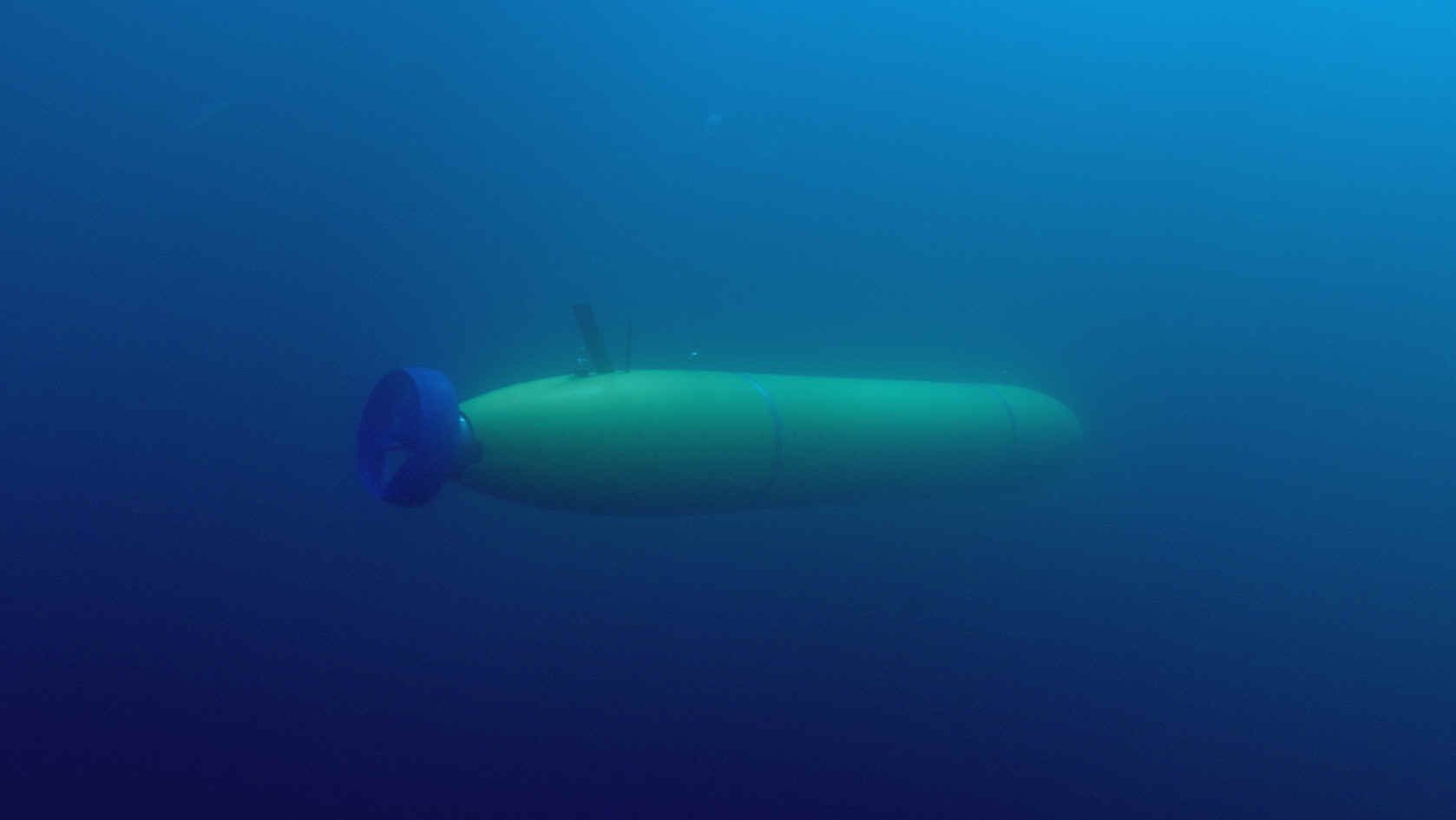
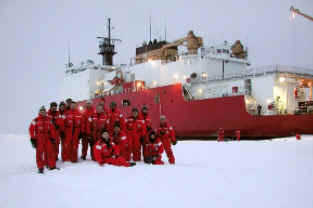
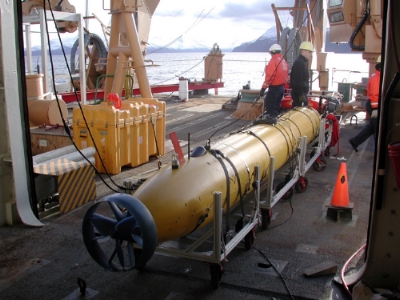
MOSS LANDING, California--After four years of work and numerous test runs in the Monterey Bay, a team of MBARI engineers took the institute's first autonomous underwater vehicle, or AUV, for a trial cruise in the Arctic Ocean last fall. The group spent a month aboard the Coast Guard icebreaker USCGC Healy, testing the AUV and its components under and along the Arctic ice sheet. The cruise was in preparation for the AUV's first real Arctic mission: the Atlantic Layer Tracking Experiment, or ALTEX. ALTEX, which is slated to take place sometime in 2004, will study the warm layer of seawater that flows from the Atlantic into the Arctic basin. The volume of this layer has increased in recent years, and some scientists believe the increase might be related to global warming.
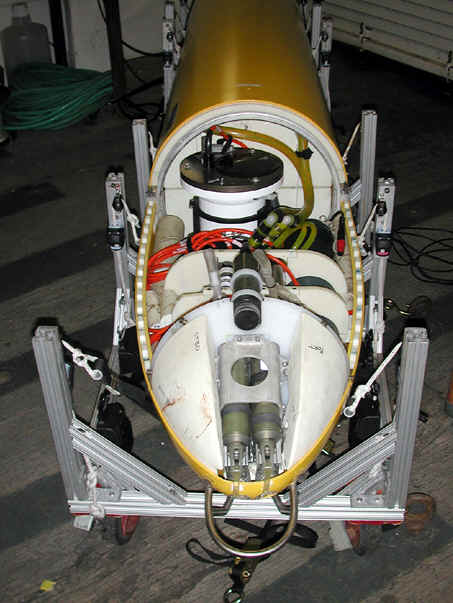
Although this new class of AUV, called the Dorado, is designed to be useful for a variety of missions, MBARI hopes that the Dorado will fill a need for new technology with which to explore the Arctic. The Arctic is a source of great scientific interest – it is still largely unstudied, and the effects of global warming are expected to appear first in the region – but marine scientists lack the tools to work effectively under ice. Most research to date has been accomplished using nuclear submarines on loan from the military, but these subs are limited (safety precautions require that they stick close to the surface), and they will soon be retired from service. And although AUVs have been used in the Arctic before, they have typically been deployed from holes in the ice, and have ventured only a few hundred meters below the surface. MBARI hopes that the Dorado, with a depth rating of 4,500 meters and a range of more than 50 kilometers, will open the region up to scientific exploration. The version of the Dorado that will be used for the ALTEX mission, called the ALTEX AUV, will be equipped with several special components. One of the most unusual of these is the ice-penetrating buoy. Because working in the Arctic is so difficult, Dorado’s designers decided that the first priority of any Arctic mission would be to recover the data collected, even if the vehicle itself was lost. With this in mind, MBARI asked an outside engineering company, Scientific Solutions, Inc., to design buoys that could transmit the data gathered by the AUV back to scientists - all while the mission was still underway. The ALTEX AUV can hold a dozen ice-penetrating buoys, each of which contain software that can download data collected by the AUV's scientific sensors. When the AUV is ready to launch an ice buoy, it slows and searches for a suitably thin patch of ice. The buoy is then released, floating up towards the surface until it comes to rest just underneath the ice cover. Seawater is pumped into the nosecone, mixing with a chemical compound, Pyrosolve-Z, in a heat-producing reaction that can melt through ice up to one meter thick. Once the buoy bobs to the surface, it extends its antennae, beaming both the data and a GPS fix of the buoy, via satellite, back to the scientists. The ALTEX AUV will also carry an ice-profiling sensor, a device that uses sonar to determine the thickness of the ice pack above the vehicle. The data it collects will be useful for scientists studying global warming, since the melting of the polar ice sheets is likely to be one of the early warning signs of rising global temperatures. One of the biggest challenges of working in the Arctic is navigation, since magnetic compasses lose their effectiveness close to the poles. The ALTEX AUV will navigate using a combination of the inertial navigation system and a doppler velocity log. The combination of the two can be used for rough navigation, and the GPS position taken by the released ice buoys can later be used to reconstruct a more accurate path of the AUV’s voyage. Aside from the modifications to equip the vehicle for the Arctic, there are several traits that characterize the Dorado class as a whole. The first of these is the tailcone, or rear section of the AUV. The tailcone comes from a MBARI design that improves both the durability and efficiency of the vehicle. A duct encircles the propeller, protecting the fins from bumps and scrapes against the ice or against the ship when the vehicle is launched or recovered. The duct also improves efficiency, by reducing the vortices of water that spin off from the fins and slow the vehicle. The entire tailcone section is mobile, capable of rotating up to 10 degrees, making the vehicle more maneuverable. The tailcone design has been licensed to Bluefin Robotics Corp., and has been put to use in military and commercial AUVs.
The Dorado has already been put to work in the Monterey Bay. In August of 2000, two early-stage Dorados joined a fleet of research vessels, buoys, and drifters in a large-scale investigation of the biology and chemistry of the upper water column of Monterey Bay. MBARI scientists will take a Dorado to sea this summer to explore the Monterey Bay submarine canyon in a dual study of bioluminescence and ocean fronts. The Dorado’s depth rating and long range make it capable of a variety of other missions, from midwater work to deep-sea vents. Ultimately, MBARI’s engineers envision an even more sophisticated Dorado that could play a role in MBARI’s planned ocean observing system. These Dorados would be permanently docked at moorings out in Monterey Bay. When an event occurred that was of interest to scientists, the AUV could be commanded from shore to gather data along a particular course. The vehicle would then return to the mooring to recharge its batteries and transmit the gathered data to the scientists. Before the ocean observatory plan can be realized, there are many technological hurdles to overcome. But Jim Bellingham, MBARI's Director of Engineering, notes that AUV technology has, in a very short time, advanced our capability to study the ocean. "Ten or twelve years ago," he says, "it wasn't clear that AUVs could provide scientific data." Today, he says, these vehicles have proved that they can deliver data sets of a much finer resolution than can be made from a ship - and in conditions most scientists and ship crews would prefer to avoid. More information on the Dorado and the ALTEX mission can be found on MBARI's AUV homepage, at http://www.mbari.org/auv/Default.html. Daily cruise reports from last fall's Arctic mission is available at http://www.mbari.org/education/cruises/Altex/logbook.htm. MBARI's collaborators on the Dorado project include MIT's AUV lab, the National Oceanic and Atmospheric Administration's Pacific Marine Environmental Laboratory, and Scientific Solutions, Incorporated.
—Author |
|
|