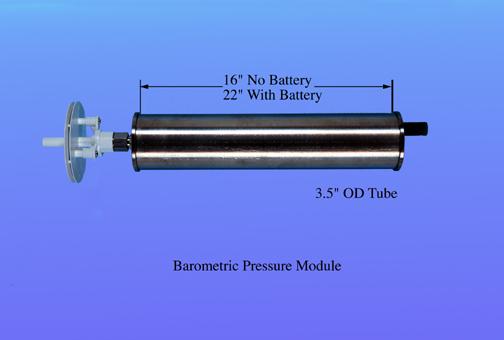
A Heise DXD (Dresser Instruments) sensor was selected for barometric pressure measurement. The sensor provides output of calibrated engineering units in ASCII for direct input to the processor board. A sample is collected from the DXD sensor every 60 seconds. Each sample is calibrated in the DXD barometer. A Gill static pressure port is used to minimize errors due to the wind blowing over the exposed sensor port. See ASIMET Sampling Definitions for current sampling details.
Specifications:
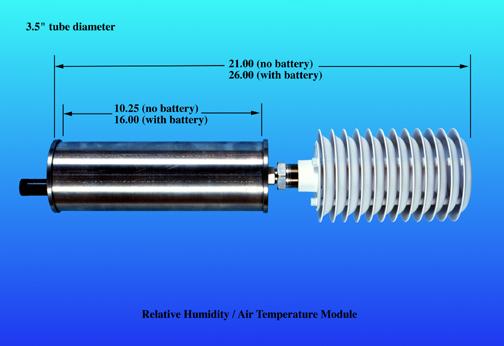
Relative humidity measurements are made with a Rotronic MP-101A sensor. To meet the environmental needs of buoys and ships, the sensor is packaged in a custom housing which is more rugged than the standard housing and with high pressure water seals. The sensor electronics is conformal coated and the sensor housing is packed with a dessicant. The humidity-temperature probe provides analog outputs of 0 to 1.0 volts DC for humidity ( 0 to 100% rh) and 0 to 1.0 volts DC for temperature (- 40 to +60 deg C). These signals are amplified and converted to digital in the module. One set of measurements is made every minute and calibrated via a fourth order polynomial for RH% and degrees C. This set of measurements is returned when polled. This probe is placed inside a modified R.M. Young multi-plate radiation shield for standard use. This modified shield has wider plate spacing and a hydrophobic coating on the plates to provide a more accurate measurement. See ASIMET Sampling Definitions for current sampling details.
Specifications:
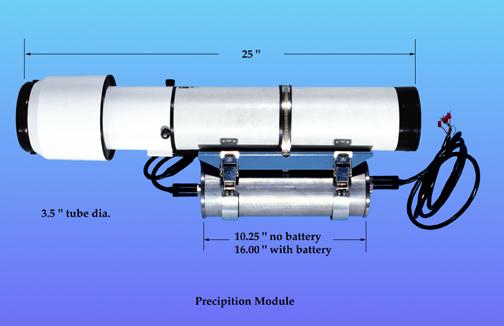
Rainfall is measured by an R.M. Young model 050201 self-syphoning rain gauge. This sensor uses a capacitive measurement technique to measure the volume of rain water deposited inside a collection chamber. It automatically empties in about 20 seconds when the chamber is full. The output of the sensor is 0 to 4 Vdc which represents 0 to 50 mm of rainfall in the gauge. The sensor is sampled once each minute and the level is output. Rain rate is calculated based on average of the last 5 (one minute) samples. The total rainfall for the last hour is also calculated. See ASIMET Sampling Definitions for current sampling details.
Specifications:
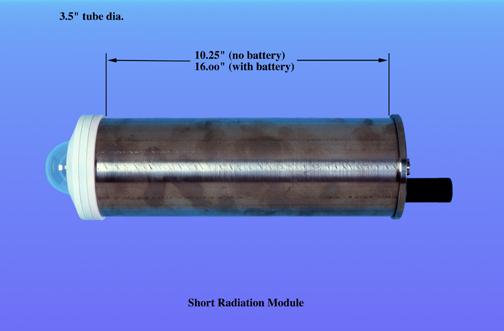
Shortwave radiation is measured with a modified Eppley Precision Spectral Pyranometer (PSP) mounted on an aluminum base which provides a reference mass for the PSP. The aluminum base is mounted to a PVC endcap for thermal isolation from the module housing. The sensor uses a temperature compensated thermopile. It provides an output voltage proportional to incident short wave solar radiation (0.3 to 5.0 micro meters). Sensitivity is approximately 9 microvolts per watt, per meter squared, and has a temperature dependence of +/- 1% over the range of -20 to +40 degrees C. A sample is collected once every 10 seconds, calibrated via a fourth order polynominal, and averaged over 6 samples for the returned 1 minute average measurement. See ASIMET Sampling Definitions for current sampling details.
Specifications:
Wind speed and direction are measured with a modified R.M. Young model 05103 wind monitor. This sensor was selected because of its proven record. It uses a propeller to measure wind speed. The standard vane potentiometer is removed and the vane shaft extended down and coupled with an absolute angle encoder for a full 360 degrees of measurement. A magnetometer compass is used to provide the north reference for use on buoys. This is can be disabled for use on ships (ships gyro and external GPS are then used to compute true wind speed in the data recorder). The propeller generates 3 pulses per revolution which has a calibration of 0.297 meters of wind per revolution. The pulses are amplified and counted over a 5 second period providing scalar wind speed. The vane position is measured once per second and the compass measured once each 5 seconds. This provides a scalar wind speed and direction every 5 seconds that is then vector averaged over the normal one minute sample period. The maximum and minimum wind speeds during the one minute time are also reported for wind gust information. See ASIMET Sampling Definitions for current sampling details.
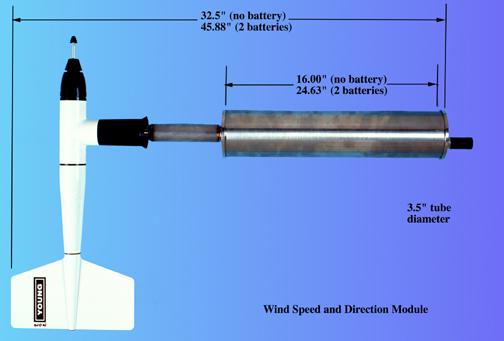
Specifications:
17 March, 2000
IMET (Improved METeorology from Ships and Buoys) modules were designed at WHOI starting in 1988 with funding from NSF, ONR and NOAA. They are very low powered, addressable digital data bus compatible, and meet the WOCE (World Ocean Circulation Experiment) heat flux data standards. These instrument modules have proven themselves by providing climate quality data in many scientific programs. Over the past several years, these modules were fabricated at WHOI for use by the climate research community including research buoys, UNOLS ships, TAO buoys, and Volunteer Observing Ships.
Since 1989, Star Engineering Inc. of Foxboro, MA has provided PC board and sub-assembly fabrication for IMET and in 1999 they began providing PC board fabrication, setup and testing as well as complete module assembly and testing for the ASIMET series of instruments. The modules continue to be calibrated at WHOI. The quality of the final product from Star Engineering Inc. is excellent. Star Engineering Inc. is the only qualified manufacture of the current version of ASIMET modules and will offer these modules for sale. WHOI will continue to provide calibration services for all IMET modules.
For additional information please contact:
    Star Engineering
    A Division of  William Jobsky Corporation
    29 Wall Street
    Foxboro, MA 02035
    (508) 543-9144
    (508) 698-0674 fax
The acoustic modem, called the "HullCom", is manufactured and is available commercially from:
    Harris Acoustic Products Inc.
    141 Washington Street
    East Walpole, MA  02032-1155
    Attn:  Tom Baldasarre
    (508) 660-6000  phone.
    (508) 660-6061  fax