Given a conceptual and technological framework for MOOS Science Experiments (MSEs), described in the following sections, we have defined major science interests for applying new technological capabilities in the next MSE. Key new capabilities are the MOOS mooring (power and communications to the seafloor, connected benthic nodes, enhanced upper water column capabilities), ISI and SSDS (connectivity to instruments and data streams), and vertical profiling (better resolution of water column structure). Within each science focus area, use cases for the new capabilities have been defined, and required measurements have been detailed. Relationships between MSE science interests and externally funded development efforts have been considered.
We have identified a primary region of interest where interdisciplinary science from the air-sea interface to the seafloor can be pursued with integrated application of new MOOS capabilities. Selection of this location was based primarily on details of scientific drivers. Because we sought to build the science around a single mooring location, it was essential to consider overlap between scientific motivations and flexibility of the infrastructure in applying new MOOS capabilities, e.g. the spatial scale of connected benthic nodes relative to the scales of processes.
The summary of current plans is a separate document linked here. The following sections describe the framework with which we began the planning process.
This MSE will be the first time that many of the MOOS subsystems will be brought together to operate as a single system in the field. As MOOS development is incremental we will be testing basic system functionality at this stage, later developments will include more capabilities.
The MSE 2004 should:
MOOS capabilities that are to be tested during the MSE will be the MOOS mooring, vertical profiling capabilitities, infrastructure software, and shore side data system (SSDS). Other assets that are not being tested can be proposed to participate in MSE 2003 such as other RV’s, ROV’s, AUV’s, gliders, etc. if they enhance the value of the science being undertaken. The capabilities of the MOOS systems that we would like to test during MSE 2003 are outlined below.
(a) The mooring will be based on the low-power mooring configuration.
(b) The mooring will have an EOM (electro optical mechanical) cable between the surface expression and the benthic expression. This provides a high bandwidth communication link between the surface float and benthic instruments and provides power to benthic instruments.
(c) Power. The mooring power supply system will generate an average of 20-30 W continuous average power. Power needs for some instruments may be met by self-contained battery.
(d) Benthic instruments can be located a few km from the location of the mooring anchor and can be provided with high bandwidth communications and power from the surface float. The total power available to benthic instruments from the surface mooring is dependent on the upper water column instrumentation power requirements.
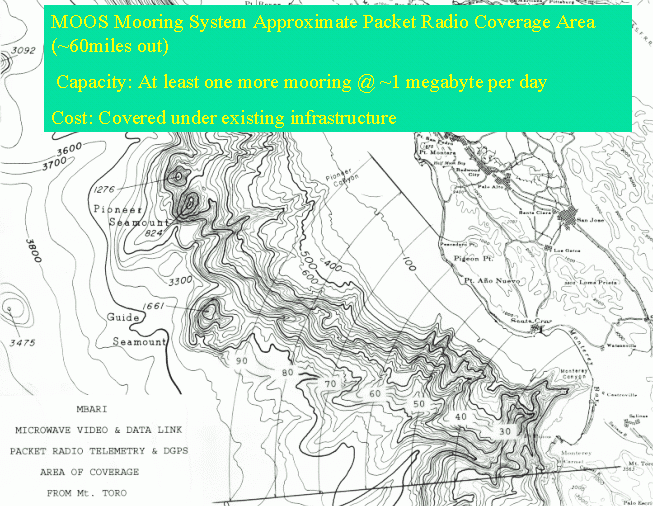
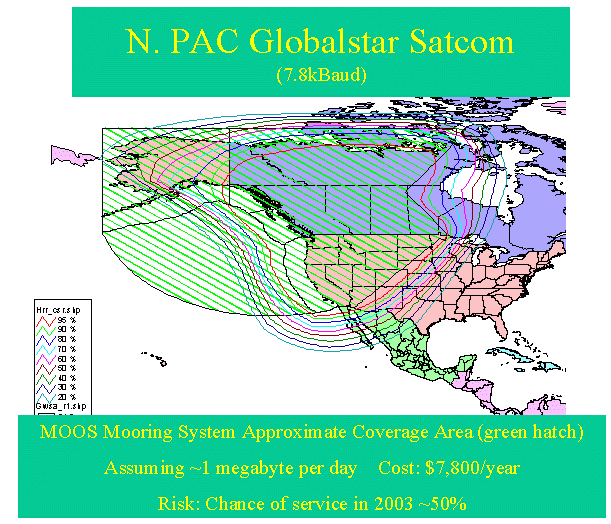
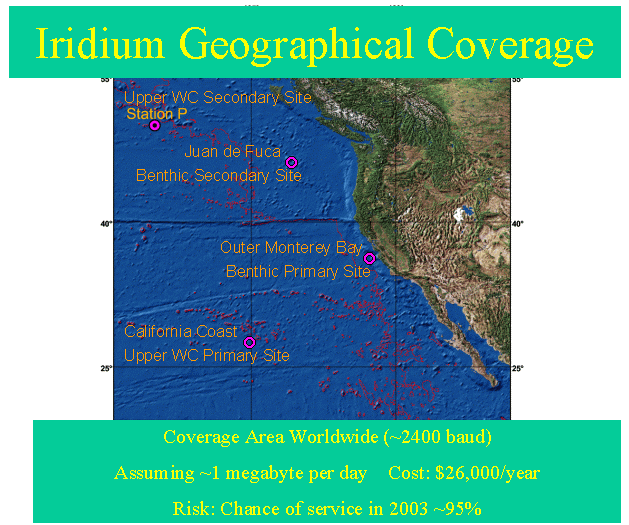
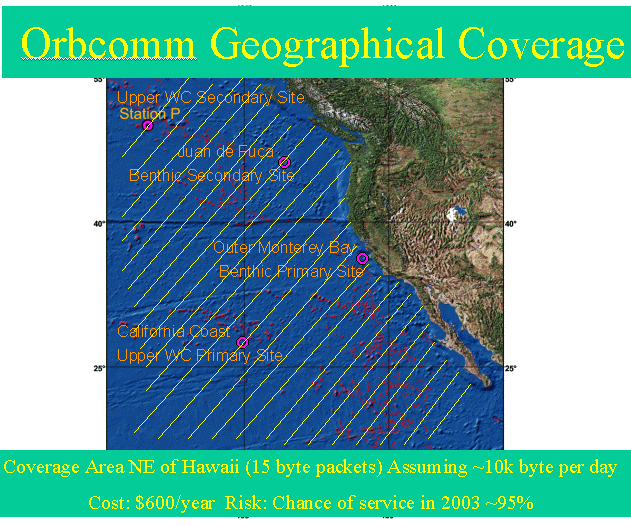
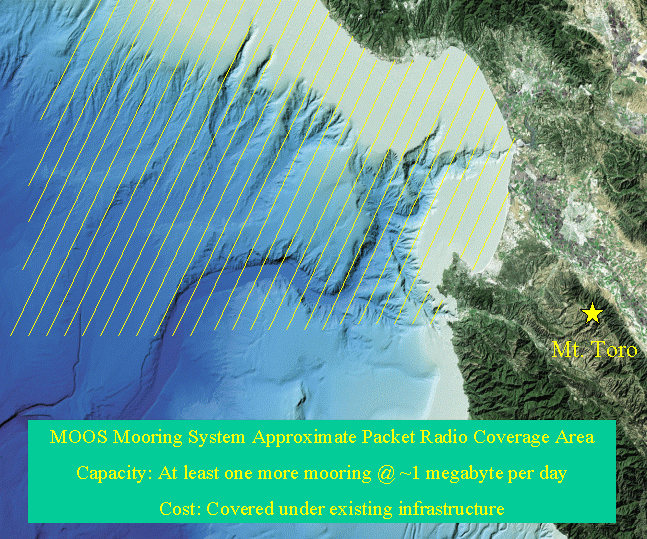
(e) Communications between the mooring and shore will depend on the method and its operating range relative to deployment location. Options include packet radio (1200 bps), TCP/IP radio (115 kbps), and satellite (100kbps for Low-Earth-Orbit (LEO), but availability more uncertain). The geographic ranges of these methods are provided as maps (Appendix A). This bandwidth will permit near real time instrument control and status as well as data delivery. This will enable event detection and near real time notification to shore offering possibilities of testing primitive options for event response.
(a) Instrument Interfaces. ISI will supply interfaces to software that talks to a network of instruments and communicates with SSDS. ISI facilitates operational deployment of instruments, including remote communication with instruments and remote control of instruments.
(b) Event detection and response. The infrastructure will support the development of remote applications that enable event detection and response.
(a) Architecture. The MSE 2003 should explore at least one feature from each of the architectural elements of the SSDS; suggested features are listed below. Overall behaviors should include the ability of the SSDS to achieve reasonable throughput/processing under highly variable loads (e.g., when a large data set is loaded).
(b) Catalog. The MSE 2003 use of SSDS will take advantage of the ability of the SSDS to reference a variety of data sets and their contents, ideally including at least one data set maintained outside MBARI. Users should benefit from being able to access the data of interest from a catalog lookup.
(c) Data Ingest. The SSDS will accept a variety of data sources, appropriately tagged to indicate their origins, and automatically process them into data sets. Data can be ingested both over ‘live links’ and as ‘offline’ inputs from an instrument (e.g., a disk drive containing data collected at sea). The SSDS should handle both low- and high-bandwidth live link data ingest. The SSDS should accept reprocessed (calibrated, validated, etc.) data, and produce useful data sets and links with that information.
(d) Metadata. Data sets that have their contents described at each of the different levels (basic only, normal, and detailed) should be accepted. Corresponding services should be provided.
(e) Data Presentation. Data from the MSE should be available via SSDS in both graphic (via web GUI) and literal (via computational interface) representations. Ability to present data in the form it was generated by the instrument should be verified. The ability of an external application to obtain data from the SSDS, process it, and return the resulting data (appropriately labeled) back into the SSDS should be confirmed.
Please note: (1) Costs are approximate and do not take data compression or intermittent links into account, but they do give an idea of the increased cost and decreased near-real-time data return as sites move further offshore, (2) Globalstar is high risk due to potential business failure, (3) packet radio could accommodate only 1 MSE 2003 mooring.