Introduction
Overview
Setup and StartupExamples
Mutiplexed by One Data
Multiplexed by Five Data
The rbnbProxy application has the following optional command
line arguments:
| Option | Description |
| -h | Print usage guide on the console |
| -x proxyPort | Proxy server port to receive data on, default 3000 |
| -a host:port | DataTurbine host and port to send data to, default is localhost:3333 |
| -s sourceName | Source name for the data stream, default is "Proxy" |
| -M |
Creates a separate connection to
the server for each channel. |
| -O cutoffDuration |
Archive cutoff duration in
seconds. By default, no cutoffs occur. A single connection (or one per channel) is created and all data is sent to it. If this value is set, then an existing archive is closed whenever the time since midnight modulo this value is zero. This means that the first file may be short, subsequent files will end exactly on intervals equal to the duration specified. |
| -N
numberOfDetachedConnections |
Specifies how many detached
connections to the server are maintained. Can only be used in
conjunction with cutoffs. By default, when a cutoff occurs, the connection is simply closed. If this value is set to something greater than one, then connections are detached. Detached connections are closed once the total number of connections reaches this value. |
| -S |
Specifies that separate threads
are to be used for each connection to the server. Can only be
used in conjunction with cutoffs. By default a single thread is used. |
| -T |
Input includes timestamps? By default, the input stream does not include timestamps. If this flag is set, then each block of data is preceeded by a time value. The initial one of these is used to set the time of the first frame of data. Subsequent values are used by to calculate the cutoff times. |
| -c cacheFrames | Number of cache frames for the source, default 1000 |
| -d diskArchiveFrames | Number of disk archive frames for the source, default 0 |
| -n numberOfChannels | Number of channels of data, default 1 Cannot be
used with -C. |
| -C
channel[,channel,...] |
Specifies the names of the
channels. Cannot be used with -n. |
| -t dataType | Type of the data (i8, i16, i32, i64, f32, f64), default i16 |
| -w wordOrder | Word or byte order (MSB, LSB), default MSB |
| -b blockDuration | Block duration in seconds, default 1 |
| -p blockSize | Block size in points per channel, default 1 |
| -f frameFactor | Frame factor in blocks, default 1000 |
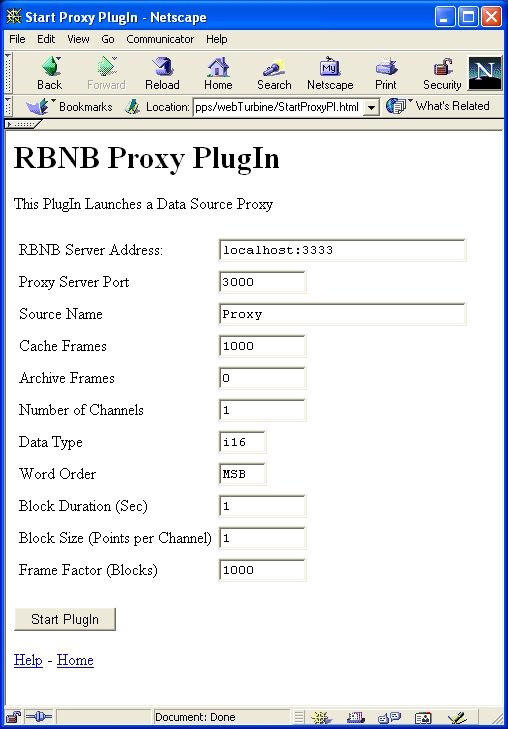
When starting rbnbProxy via the WebTurbine interface, simply configure these options directly on the form, as shown below.
Larger frames are more efficiently handled by the DataTurbine server, but introduce a larger latency into the system and require larger intermediate data buffers. In general, 1 to 50 frames/second provides a good balance between efficiency and latency for many data acquisition systems. Note that the frame factor times the block duration is the update interval of data from rbnbProxy to the DataTurbine server.
If the acquisition were at 500 Hz, the block size would remain 1 point, but the block duration would increase to 0.002 seconds and the frame factor would decrease to 250 blocks.
If the acquisition were at 500 Hz, the block size would remain 5 points, but the block duration would increase to 0.01 seconds and the frame factor would decrease to 50 blocks.