I was glad to not have gotten seasick on the Rachel Carson this Monday -- staring at the horizon really does help. The highlight of the day was seeing both Pacific whitesided dolphins and right whale dolphins swimming in front of the boat!
Back on shore, I'm excited that my code generates data. It'll be exciting to run lots of data through it to see longterm trends in ocean activity.

|
Monday saw my PC sulking on me, alternating between crashing ArcGIS and Excel.* Then tuesday the driver for the mouse just decided to randomly cut in and out. Despite all this I have finishing compiling my primary data set. As ever there is always the desire to collect more data, but I can work with what I have and if time permits I can collect more. So my time is now spent sifting through that data and checking out erroneous measurements and seeing if there is a reason for any data outliers. After that I can move onto analysis, and the bit where I apply my brain to work out WHY things are behaving the way they are (that's the engineer in me coming out). The more I think about, the more fascinated I am by the high resolution of this data. Previous papers on tectonic extension have had to use proxies and take well-educated guesses into the amount of tectonic extension over spreading ridges. This data set is as good as looking at large scale land based fault systems. Wonderful stuff! I know Ben is doing well from the graph he excitedly waved at me yesterday. Which looked good. I also know a lot more about Laughlin's project than anyone else's work. Fascinating stuff and well explained. (Though I think the hamster powering the pump might be limiting!) Then yesterday I received the news that a berth had become available for me on the rv Western Flyer for the Clague cruise in late August to beginning of September. I would love to go, it would be a truly wonderful opportunity to see how the data is collected. BUT, the visa and immigration issues. I'm currently being shunted from the US to the UK sponsor rep to discuss if it's possible to process the extension in time. So either a late night for me, or an early morning tomorrow, in order to catch the UK during business hours. If this doesn't work out there is a chance (if someone drops out) that I can attend the April 2015 cruise which is going over the area I am currently studying. Big push to the universe that things work out. Still working my way through the Pink Floyd albums, but they are now interspersed with Philip Glass, Steve Reich, Mozart, JJ Cale, and assorted blues artists. Aikido continues to be wonderful, but I have no skin left on my elbows today and had to wash the blood out my gi last night. *Latest update. Zorba has weaved some for of computer magic and so far my computer is behaving.
 Posted by kwillis at Jul 17, 2014 10:01
|
|
We just completed direct comparison of zooplankton characterization from microscopy on Gulper samples with that from LISST-HOLO. For the two AUV surveys (2013.226.01 and 2013.226.03), the results are consistent: HOLO was not seeing the zooplankton community. This disparity is likely due, at least in part, to the plumbing system. Also, I completed my 100th dive today!
Posted by lziccarelli at Jul 17, 2014 14:36
|
|
Data collection and entry might be mostly finished, but I still have to fill in the gaps. Even just the slightest change to my methods along the way now requires a complete overhaul through the plethora of videos I examined. I am just a lowly excel slave at the moment, but I will be a slave to VARS soon (an upgrade, no?) The whales are very distracting, but not as distracting as good surf, so I am thankful for the flatness (not really, but sort of).
Posted by bburford at Jul 17, 2014 15:57
|
|
I have a working C++ code for tracking jellies. I also made a stripped down version to attempt to run on the target. Unfortunately I have not been able to successfully install opencv on the embedded system. There seems to be an unstable answer...but it's not stable yet. I may have to switch to a different program to get computer vision code running on the target.
Posted by jsteck at Jul 17, 2014 16:01
|
|
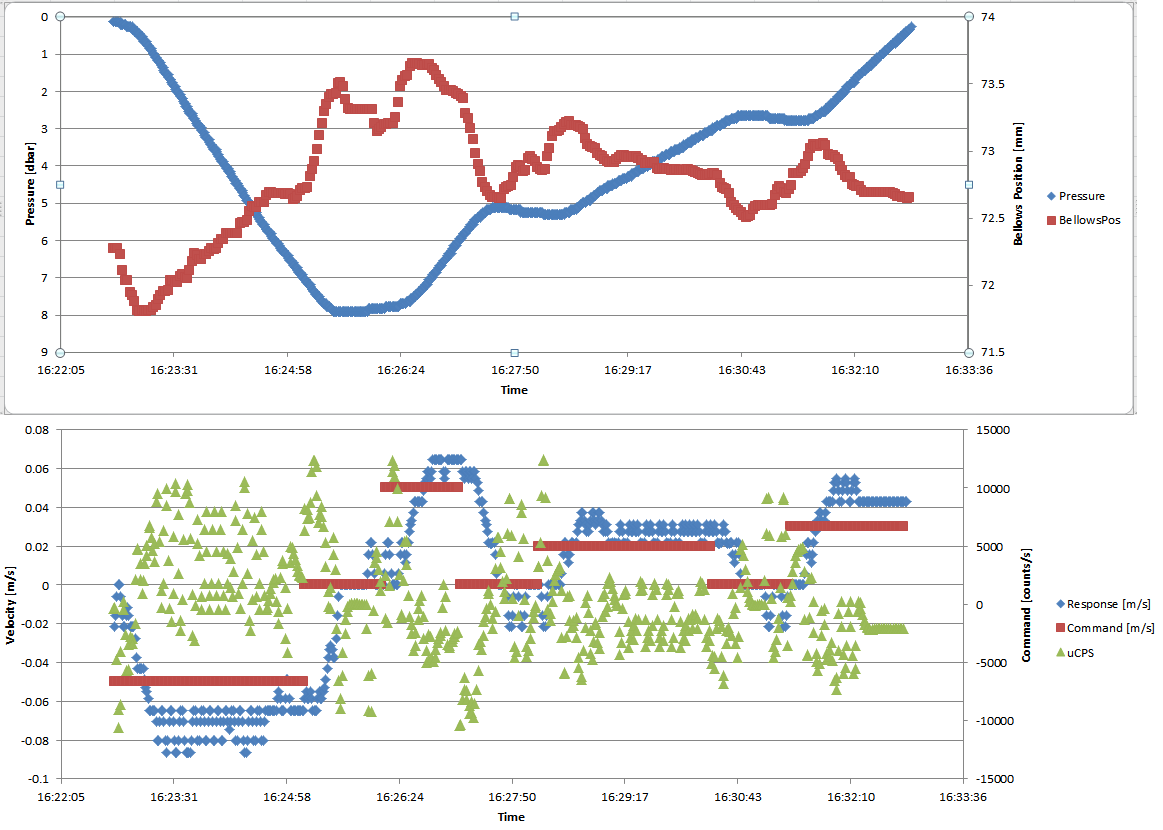
What do they say..."Graphs say a thousand words?..." sure, why not... Got rough speed and depth control of the prototype float working on an existing control algorithm (after eating Corinna's delicious cake). On the first graph, the Blue line shows depth of the float in the tank. Notice the smooth descent velocity, dP/dt, and rough ability to hold position (the flat areas at 8, 5, and 3m). Red line is bellows position, and is more diagnostic information than anything. It tells me: "there is air trapped in your system, and I'm going to behave non-linearly as a result." Second graph is more diagnostic information. Red color shows the commanded speed, with blue showing actual platform speed (if you integrated those blue dots, you'd get a profile approximately like that of the blue line in graph 1). Green shows pump speed, and as you can see the pump is constantly running and making corrections (wasting valuable energy for something that's supposed to last months in the ocean!). After modifying and further tuning the control algorithm, I will drop in some logic that will sleep the system for long periods of time, and only make a correction if some criteria (e.g.if error_position>5 m, or error_velocity>0.05 m/s) is met. Then I will test, plot, modify, repeat!
Posted by lbarker at Jul 17, 2014 16:35
|
|
Data crunching has been coming along nicely. The amount of data I've working with frequently causes Microsoft Excel to crash, so I've learned to save very often. I am currently in the process of working out with my mentor(s) what to do with all this data, and hopefully something coherent will come of it. Happy end of week 6 everybody!
Posted by wtruong at Jul 17, 2014 16:57
|
|
I have moved to the imaging lab to begin collecting information on the assemblage of traces at Stn M (diversity, density, etc.). It will be a busy few days of solid image annotation: 115 photos down, ~1300 to go! I am hoping to have it all done by the end of next week.
Posted by jdurden at Jul 17, 2014 17:22
|
|
I have spent the majority of this week working with Frank in the machine shop. My design for the frame of the suspension system for the MBA exhibit is done and I am now getting to fabricate the design myself. I have been using the mill to slot and drill different components and using the band saw to create parts with a combination of different angled cuts, and working with various other machines as well. It has been really satisfying to be a part of the engineering process from end-to-end and actually see my design become a physical product!
Posted by nreed at Jul 17, 2014 17:34
|
|
I have spent most of the week digging in the freezers to find missing samples (the database entry '??' to indicate freezer number and location was quite helpful) and extracting DNA from those (I have come to the conclusion that I don't like adductor muscles). Fortunately, however, most of the isolations worked in the end. After making the final decision about which genes we want to include in the analysis, I will be busy in the lab sequencing all remaining individuals. I hope that I can finish everything until the end of the internship.
Posted by cbreusing at Jul 17, 2014 20:45
|
|
Jon, check out the opencv install tutorial at http://elinux.org/Jetson_TK1, this may help get you through the maze.
Posted by tm at Jul 18, 2014 07:45
|
|
This week has seemed to be quite slow on progress but at the same time some real questions have come to light and the report may contain more than originally thought. Last week I wanted to be finishing up more core logging but that is going to be a 'copy and paste' to this weeks update. I have only managed to log two this week - 10 to go (easily manageable by the end of next week if nothing else crops up, even with a short week). The reason for the slow progress is the arrival of my grain size data that I spent the week before collecting in Santa Cruz. When plotted it shows some pretty interesting (to me and maybe Katy W anyway - the non-bio people) results in that grain sizes from 70 MAB within the canyon are not found at the same height on the sides of the canyon in shallower waters but are in deeper waters. taking a simplistic view, this is the wrong way round. Same long discussion with various people and I feel I am at a place to start answering some of the questions this creates (I won't bore everyone with the details but if you're interested i'm happy to talk about it!). What has been really helpful is getting raw data from someone at the USGS from a paper he wrote this year that I am directly comparing to. Thursday was a long day. I headed up to Menlo park, next to Stanford, to another USGS facility. Early on in the internship my mentors were on a cruise around the San Diego area where a bunch of cores were collected. Yesterday was the day they split them so asked if I could go for another pair of hands. So typically, cores are collected in plastic tubes and then to split them, they are rested on a rack and two small circular saws are run up either side and then thin wire run down the middle of the core so you end up with two halves. Cores from MBARI however are different in that metal core tubes are used. This means that a handheld electric shear needs to be run up one side and then the other, effectively doubling the amount of time you take to process a single core. It also means that two people are needed for the cutting process, one to cut and one to hold. Once cut, they are cleaned up by removing the top layer of sediment and then sent for photographing. I think there were maybe 50-60 cores to complete and it was a nice 13 hour day! If nothing else, it helps explain why some features in the cores I am studying cannot be explained geologically and can be by seeing the force that the shears and whoever operating them applies up and down each side! So I hope to be at a stage next week where my grain size data has been interpreted and all cores are logged so from then on the report can be filled in!
Posted by wsymons at Jul 18, 2014 10:27
|
|
This week I've been doing the following: Results so far: sequencing for Pterygioteuthis looks good, sequencing for Vampy looks okay, sequencing for Dosidicus will be done in 10 min!
Posted by thersh at Jul 18, 2014 15:28
|
|
This week has been crazy busy. So after talking with my mentor, I decided to challenge myself and add more to the project. For the past 3 weeks or so I've been working with the Micromonas strain RCC299, but my mentor and I agreed that it would be good to do the same experimentation with another strain of micromonas which is CCMP1545, and compare the results. So, I've spent the past couple days transferring and trying to revive those cultures since they've been sitting in the incubator for a while, while continuing to do the experiments with RCC299. We also decided to add intracellular allocation to my project.
Posted by amaitland at Jul 18, 2014 18:13
|
|
This week was insanely busy! I have been having to take care of 40 cultures every day, which has been a huge time suck. Hopefully next week I will be able to start writing as I should have enough time. crossing my fingers.
Posted by zjensvold at Jul 18, 2014 20:05
|
|
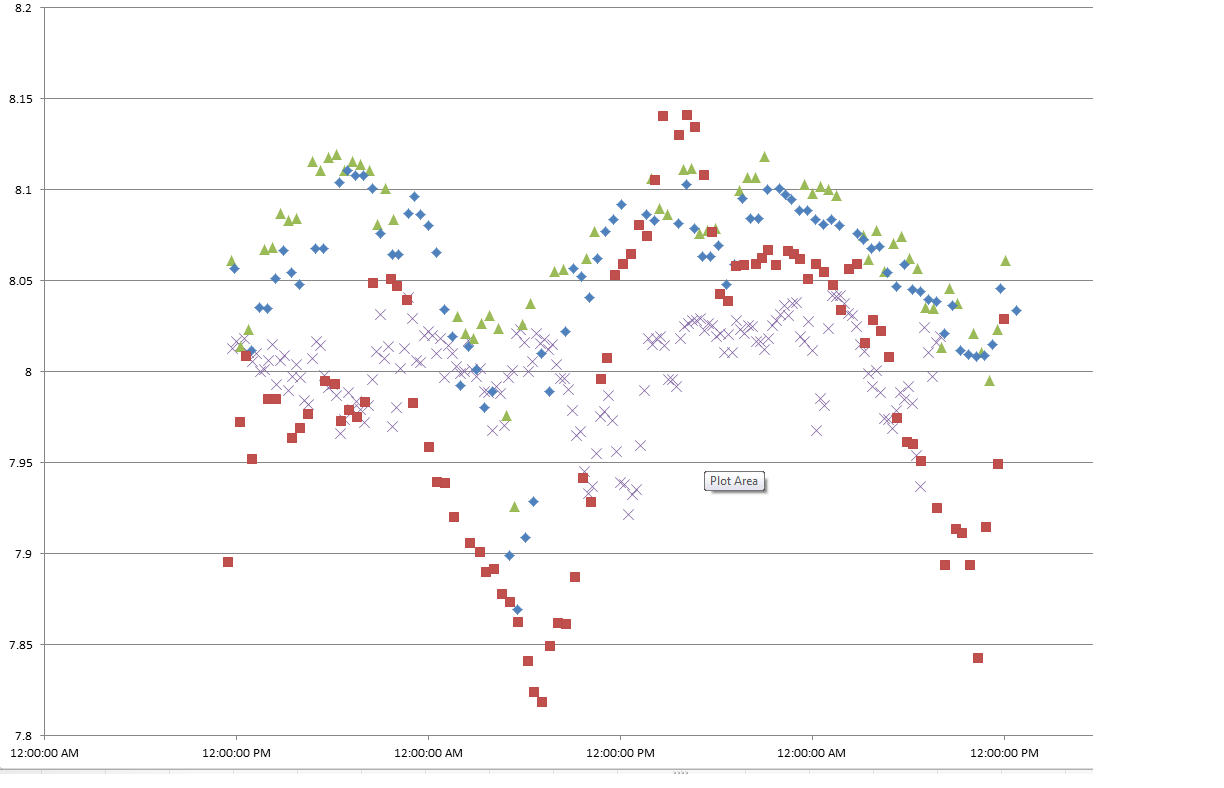
This week I went out with Kerry Nickols of Hopkins Marine Station fame to collect water samples at my 9 pH sensor locations offshore of Hopkins. I collected DIC, chl, nutrient, and salt samples. Margueritte taught me how to run chl samples in the lab, but the others are apparently too complex for my intern brain to handle. I've also been emailing people about how to get data from the remote sensors that they run (PAR and ADCP). I've started processing data from my drifter sensors (which send a voltage via cell phone every half hour that I then convert to a real pH value using mathematics) and MBARIs OA1 mooring, which will act as my perimeter sensor. The graph below shows 2 days of data from the 4 sensors I have data from (7/14 - 7/16; y axis = ph, x axis = thyme) 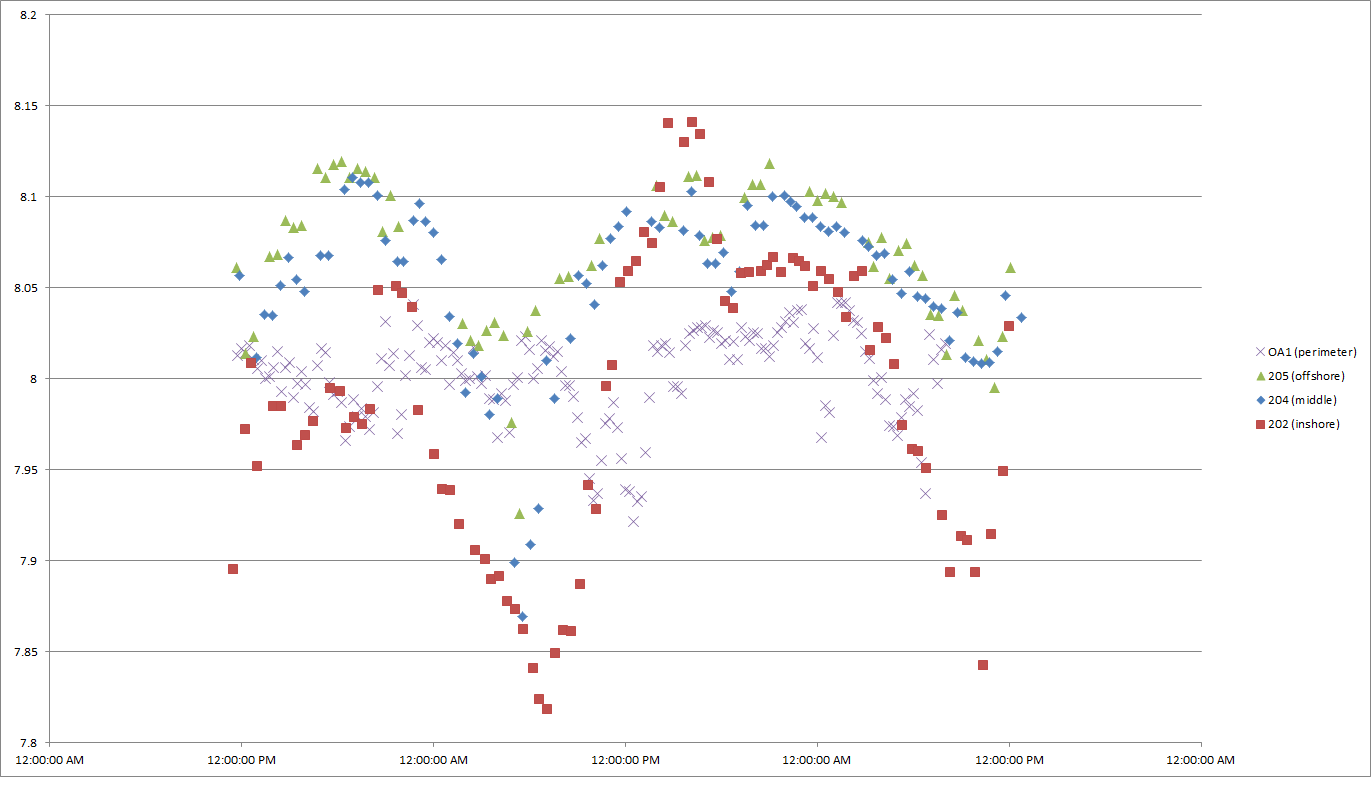 Posted by jlafian at Jul 19, 2014 10:22
|
|
This week I continued analyzing squid videos and also started dissecting preserved squid. I'm finding some differences between small individuals and large ones (the larger ones develop a yellow pigment in their lens and have a different posture) and I'm trying to determine whether the large squid are older/mature individuals or whether there is possibly a sexual dimorphism.
Posted by kthomas at Jul 19, 2014 10:54
|
|
This week I continued to work on the LRAUV simulation. I re-wrote code to calculate elevator and rudder lift and drag terms in higher detail and continued to tweak and fit the model to provide a somewhat realistic representation of the vehicle's behavior. Unfortunately, I'll probably have to put a little more work in to the model next week. Once I'm done fitting the model I'll derive residuals (between modeled vehicle behavior to observed) and proceed in building the second piece of my classifier. Hoping to start my write up towards the end of next week.
Posted by byraanan at Jul 19, 2014 19:38
|
|
This week I continue analyzing fish larvae abundance data regarding latitude and distacia the coast. I made graphics for fish larvae vs adult from 1950-2002 and finally I worked interpreted the double integration equation.
Posted by vanessa at Jul 20, 2014 13:56
|