|
Week 2: No problems to report (besides the two decomposing seals on the beach...yuck). The week flew by quickly and I feel as though I've gotten many things accomplished. Some of the biggest issues with both the samples and exhibition database have been taken care of with the help of Joe Gomez. Now all of the hyperlinks work on the exhibition database and you can view all 19,677 samples stored in the sample database at once. If you want to see how everything is looking so far here are the links: New Server (WIND): Sample DB: https://wind.shore.mbari.org/samplesDB/Queries/ Highlight(s) of the Week: My new cat mug. Meow.  Posted by arredondo at Jun 18, 2015 08:35
|
|
This week marks my first real week of work at MBARI, and all has been great so far! I have learned a lot about the acquisition of the gas samples with which I'll be working this summer through watching film of the ROV dive in the video lab, looking at maps of Eel River Canyon (where the Brewer Lab collected the samples), and reading about gas hydrates. I learned how to operate the Raman system in our lab and practiced acquiring spectra of different minerals and liquids. Based on the peak shifts in a spectrum, I am able to identify the chemical components of a material, which will be very powerful once I begin to study the Eel River Canyon samples. Most excitingly, two members of the lab and I drew out a system that will allow me to compress the gas samples to high pressures to mimic the deep sea conditions where they were collected before taking Raman spectra. We built the system yesterday and began checking it for leaks, and I'm hoping that we'll be able to test it in conjunction with Raman today. I've also been learning a lot about other projects at MBARI and got the opportunity to see the CO2 seawater enrichment tank at Hopkins that is crucial to the shallow water Free Ocean CO2 Enrichment project. Seeing extent of collaboration within MBARI and with other research institutes really inspires me!
Posted by kmccone at Jun 18, 2015 08:41
|
|
This week is going by so fast it's almost scary. Other than that I've been having a great time. On 20150615, I was given the scope of what I'll be doing this summer which, in a nutshell, is creating a program that can fetch float data from an online database and have the program spit out some specific info (such as the percent saturation of oxygen the float collected). The program will then compare the data it retrieved to another database and calculate the correction (in terms of differing oxygen data) between the two. Eventually, Carole would like me to have some sort of map with all the locations of the floats where the user can click the dot and then it will do its magic and show the data. It all sounds super cool, because I've never done anything of this magnitude. When I first started typing out the code for it I simply had the program store the url of the database into a variable and then have the program read the variable to then store its contents...but for some reason it can't parse the data correctly and it gives me some errors. I then downloaded the file onto the computer to have it run locally instead of making the program fetch it over the web. Funny enough it worked offline. So basically I'm trying to make the code run locally first and then transmute the code so it can run online. Its pretty cool nonetheless. The DOEST reception at the end of Tuesday was a pretty interesting experience, meeting some of the board members and talking to them was a nice experience. Granted it took me some time to muster the courage to talk to people, because I'm a pretty awkward/antisocial person if I don't know you. The barbeque was also really cool (I just love me some food).
Posted by jramirez at Jun 18, 2015 09:52
|
|
Early this week, I found a method in which I was able to effectively measured twenty-three lengths on the color calibration board, both on VARS and the physical board. Right now I am repeating the method on VARS so that I have thirty measurements of each of the twenty-three measurements I made, to determine the precision of each measurement. I imagine it will take me a little while to make all thirty measurements, as I am currently only on my sixth...mainly because yesterday I enjoyed a day at sea on the RV Rachel Carson and got to watch very skilled pilots attempt to recover a buried sediment trap with the ROV Ventana! But once I finish the thirty measurements, I will measure the angle of each of these lines from the laser line (so if anyone has a protractor I could borrow please let me know!).
Posted by peart at Jun 18, 2015 10:22
|
|
This week has gone really well. I how now purchased or found all of the parts to start building a second CO2 sensor. The code that runs the existing sensor is now mostly operational, and I discovered pretty much everything wrong with it was my user error. Next week I hope to build the second sensor and start doing some calibration on the existing sensors. They will eventually be placed in Elkhorn slough to collect daily CO2 data.
Posted by wolfe at Jun 18, 2015 14:27
|
|
This week I think I have actually made some progress on my project. Last week I was quite overwhelmed with all the work (aka Matlab) that I had to do to actually get results from my project. This week however, Kakani sat down with me multiple times and we set clear goals to be accomplished for the week, which made this week a lot better. I began with looking at videos captured of jelly fish from the LRAUVs and then picking out the videos with higher concentration of jellies in them. Each of the videos are only about 60 seconds so I used code from a previous intern to look through each frame of the video rather than just going through them quickly. Now my job is to manually find the orientation of these jellies in the video. The previous code already found the orientation of them so we are trying to see the accuracy between the code and the manual calculations. I am still getting comfortable with Matlab but the more I try things on it the less daunting it becomes (hopefully)!
Posted by sblack at Jun 18, 2015 14:36
|
|
I've made a great deal of preparations for next week. The scope is now ready for the phytoplankton counts and I have reviewed relevant material to begin genetic analysis of CANON15 samples. MATLAB is still the bane of my existence and I have had to pass the torch to Reiko, but I will continue trying to learn the language. Also, I enjoyed talking with Eric Hartwig again at the DOEST reception.
Posted by lziccarelli at Jun 18, 2015 14:45
|
|
June 18, 2015 Week 2 The majority of my lab group is out on the R/V Western Flyer for 10 days so I spent a portion of the beginning of this week helping them load and unpack their gear. It is really amazing to see the amount of equipment that Ken's lab takes to sea and having the ability to be part of this process has provided me with a glimpse of the organizational skills required to be successful in this field of research. On Wednesday I went on the R/V Rachel Carson with Sam, Katie, Beatriz, Alice and Alexa. They were using the ROV Ventana to locate and attempt to recover a sediment trap that had been buried. Unfortunately, the equipment was buried too deep and they ended up having to cut the cable to release the buoys so they lost the equipment and the data.
Posted by jwhelpley at Jun 18, 2015 14:48
|
|
I did some research on the noise that I was getting from the electronic load on Monday and found out there was oscillation at the output of the electronic load. I spoke to Chad about it and he asked me to do some research on ways to reduce the noise level. I did some research on Tuesday and Wednesday, we decide to add a low pass filter, a gate resistor and some capacitors to filter out the noise. The component that I ordered arrived yesterday and so I was able to get started on the other part of the project. So far, I have been making a lot of progress on the project. I really enjoyed the reception on Tuesday! I spoke to several people and it was a lot of fun hearing what they have to say. I also enjoyed the BBQ we had yesterday! I had fun cleaning up as well!
Posted by achen at Jun 18, 2015 14:53
|
|
Larvacean Log, Week 2: Took a trip on the Rachel Carson this week! On Wednesday we left sharply at 7am and were greeted by sea otters, sea lions, and humpback whales on our way out. We were looking for a buried sediment trap around 1280 meters deep. Even though it was located with the Ventana, turns out it was buried super deep and thus could not be extracted... Everyone on the Rachel Carson is completely wonderful and hilarious. On the way back, we saw a plethora of whale tails and a massive pod of dolphins. In other news, I have eliminated two more methods for tracking the larvacean motion and am closing in on a third. Matlab skills are getting better at a faster rate this week, which is a big improvement. And we go on our certification dives this weekend! Super excited to dive in the ocean.
Posted by abaumer at Jun 18, 2015 15:26
|
|
Week 2: On Monday and Tuesday, I made into Matlab files data from the Biological Oceanography Group (BOG) database. On Tuesday, I met with Steven Bograd of NOAA (in Monterey, with Dave Anderson and Mike Jacox of NOAA), and we discussed my summer project. On Wednesday, I went on the Rachel Carson to retrieve a sediment trap, (well, I watched others attempt to do this). I also finished reading a classic paper on upwelling in the California Current by Adriana Huyer that I should have read already. On Thursday, I met with Francisco Chavez (with Dave Anderson) who will also be helping with my summer project. I also gathered and almost completed my preliminary list of all observational datasets that have O2 data in this region. I will focusing more on understanding the datasets that I have retrieved and making them into intuitive, usable form (likely through matlab). By Friday, I should have a good understanding of the BOG database.
Posted by aren at Jun 18, 2015 15:30
|
|
So just backing up a bit, I am working on the acoustic classification of underwater mammals(whales,dolphins etc) i.e classifying them using their vocalizations. Most of my last week was spent learning python, supervised machine learning basics and also extracting audio specific features(around 25 features) which are an essential part of the classification process. Just to give you an idea about how a classifier or any supervised machine learning algorithm works, consider an enthusiastic novice chess player, yes he knows the rules and the idea behind the game but doesn't exactly know the best way to proceed and win the game (due to no experience with chess) , but as he plays more and more he gets better at it(learning from previous games) and thus increasing his accuracy(or winning percentage). Similarly an acoustic classifier is equally bad(or worse maybe) when it doesn't know how to classify , so we need to feed a lot of data to it so it knows how a beaked whale, dolphin, blue whale etc sound like. The classifier learns from this data and whenever it comes across a new acoustic encounter , the classifier should predict the class(beaked whale, blue whale, dolphin etc.) to which the acoustic encounter belongs, but remember the classifier will make mistakes! ( and also the chess player). Currently I am working on the extraction of data (from the data set given by the Scripps Institute of Oceanography) and putting it into a suitable format so that our classifier can read this data and learn from it.
Posted by pmurgai at Jun 18, 2015 15:39
|
|
I hope that this will post, as I am writing from station M. The seas are currently 5-10 with wind gusts around 20, but it is true what they say, the Western is a stable ship, and one hardly notices the pitch. We arrived on station over the Benthic Rover early this morning, and while we were able to communicate with the vehicle, we were unable to trigger the weight release. After exhausting all options and taking advantage of the best weather conditions we are likely to see, the decision was made to send the ROV doc ricketts down to release the weights manually. It takes about 4 hours for Doc to reach the 4000M depths, and after sorting out some navigation issue with the ROV, the crew successfully pulled the pin releasing the rover which is currently make it's 2-3hour ascent. Once at the surface our real work will begin. I will be taking as much video as possible to document this trip, and will hopefully have some cool stuff to show for my time away from the island.
Posted by dburrier at Jun 18, 2015 15:42
|
|
Week Two: This week although seemingly short, has been both challenging and productive for a number of reasons. I started the week off with retrieving my computer system from Zorba, for which I had submitted a Help ticket last week to have a drive with windows 64-bit installed in order to allow for operation of Solidworks 2015. Following the physical setup of my new machine, I managed to track down MBARI's Solidworks 2015 Network License and install Solidworks, which took quite a bit of running around. I also was able to speak with Todd about gaining read/write privileges to the project libraries I need to access. Brian Kieft went over the LRAUV's current ballast and trim procedure which gave me a much better understanding of the existing process, and somewhat of a starting point. Jon Erickson has been an enormous amount of help this week with all things Solidworks, including setting up the solid model of the pressure hull assembly as a starting point for a portion of my project which would include adding phantom masses to the model to more accurately represent the actual center of gravity of the LRAUV. The challenges this week would definitely include the lack of support in my lab as everyone but Brian has been on vacation starting last week. Being that Brett is currently in Indonesia, it took a couple of days to hear back about which path to take in addressing my project goals. In the coming weeks I am looking forward to diving into the project a lot more and hopefully accomplishing a significant portion of the project goal.
Posted by rchavez at Jun 18, 2015 15:44
|
|
Finally got those files converted! Lonny from the video lab was able to find some time to reformat most of the ROV data I needed to continue my research here at MBARI. Earlier this week I entered, and now that the week is over I guess one can say i'm exiting, phase two of my summer research project. Phase one was reviewing the archived ROV data Dr. Charlie Paull et al. collected from Arctic dives in the years 2010, 2011, and 2013. I used VARS to mark whale marks as I saw them in the video files. For phase two I'm almost done analyzing and collecting my observations into a dataset which is growing pretty large! Hopefully by tomorrow I will be finished with my dataset and can move on to phase 3... the actual research part of my internship. I need to use my dataset to first decide what whale specie/species is making the depressions. Then I will start the process of coming up with an idea for why they are attacking these areas... Ohh and sum stuff about tracking the distribution of the whale marks. Looking forward to a great week 3.
Posted by psmalls at Jun 18, 2015 16:03
|
|
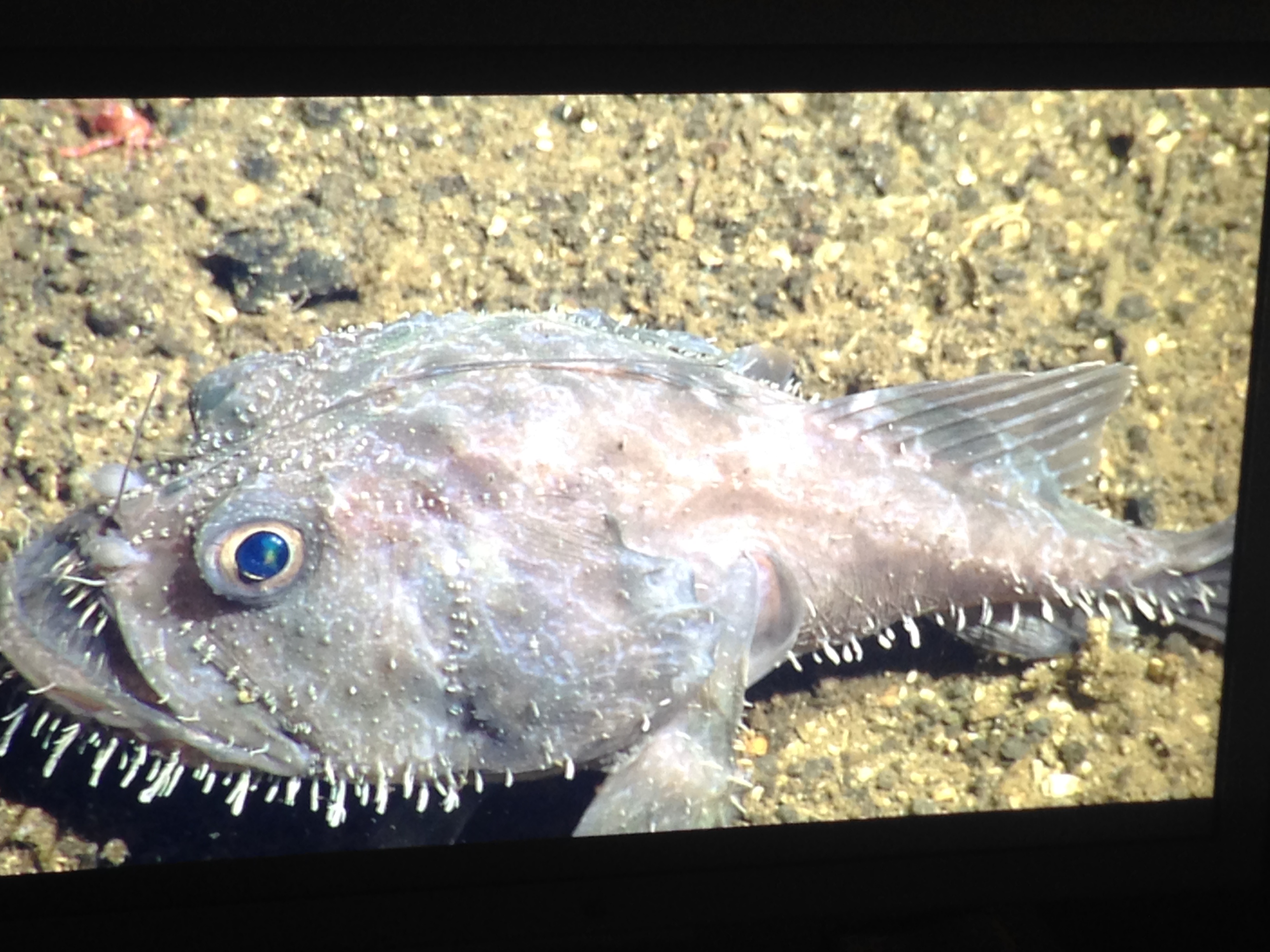
Week two: In my second week I was going deeper in the sea. I found some amazing organisms which I could identify using my knowledge, which made me really happy. It is unimaginable how the deep sea organisms can show us so many adaptations to live in that environment. I could see at a fish closely and noticed his eyes are looking for food or maybe being alert when there is a depredator and movements including walking and jumping. Also, I had an extraordinary adventure on the Rachel Carson with other interns. We went and recover a sediment trap using the ROV Ventana and we had the opportunity to watching all the procedure and some species that were there. The rest of the week I am focusing on organizing my biological and environmental data to start working in the analysis to see differences among the places visited in the Gulf of California.
Posted by bmejia at Jun 18, 2015 19:26
|
|
Week Two: At the beginning of the week, I found a super plausible explanation of how the radiolarians could form their geodesic structures (it's so elegant, ask me about it), and now I'm working on finding a stain or other method by which we can look at them and see if their microstructure supports that explanation. This is proving harder than I thought, though...more research to be done there. But MLML emailed us back about using their SEM, so either next week or the week after we'll get to take more pictures (and get more data!). I spent Wednesday out on the Rachel Carson, which was awesome. We saw sea lions, otters, whales, dolphins, jellyfish, and crabs! I also really enjoyed meeting and talking to the crew and watching the whole process of trying to find the lost equipment and then decide if and how to recover it. On Thursday I was in lab all day long (that's my excuse for forgetting confluence lol). I learned how to find samples in the -80 freezer in building G, isolate DNA from the samples, quantify the amount of DNA we got, perform PCR to multiply a desired segment of DNA, and do gel electrophoresis on the DNA. I also got to see the Sanger sequencing machine and learn how it works. Busy day. I also really have to pay attention because I've found that after I learn something once, the next time I'm expected to do it by myself! I'm learning so much in so little time. And I didn't even include activities outside of work this week!
Posted by beittenmiller at Jun 19, 2015 08:31
|
|
This week has been very busy but I have enjoyed every second of it. Monday was the first day of working with my mentor, Charlie Boch, because he was at Woods Hole last week. That day was a little bit overwhelming because I had to prep for my project within 3 days and I still did not know what I wanted to do yet, and in the meantime I assembled 110 Falcon tubes that required the lids to be hole punched in the center (a lot more work than it sounds like) and a complementary 65 micron Nytex mesh to keep the fertilized embryos from falling out while being incubated. Tuesday we did everything to prepare for the big fertilization experiment the next day, and I was busy learning how to take care of abalone and keep them content. Wednesday was a 16 hour day of non-stop experimenting. I was rushing to set up my own project that tests the development of abalone in different environmental conditions that are commonly associated with ocean acidification, such as low pH and low dissolved oxygen. I'm still surprised how our team of 10 was able to perfectly execute our complicated experiment (I won't confuse you with the details) and my first shot at setting up my own experiment has a few problems but now I know what to work on for our next iteration of abalone spawning experiments in July. Thursday was the day I took some of my abalone embryos (my beloved babies) and fixed them with formalin for science. I'm not too proud of it and I feel like a bad mother...but it's for science!
Posted by mheard at Jun 19, 2015 08:48
|