Click on the AD!Current profile.png!D comments box below to post your update
 M1_Parameters_16Jun16.png (image/png)
M1_Anomalies_16Jun16.png (image/png)
M1_Parameters.png (image/png)
M1_Anomalies.png (image/png)
Current profile.png (image/png)
Current profile.png (image/png)
CPF_Dynamics_18_Feb_98.tif (image/tiff)
Simulink.png (image/png)
Simulation output.PNG (image/png)
photo 3.JPG (image/jpeg)
M1_Parameters_16Jun16.png (image/png)
M1_Anomalies_16Jun16.png (image/png)
M1_Parameters.png (image/png)
M1_Anomalies.png (image/png)
Current profile.png (image/png)
Current profile.png (image/png)
CPF_Dynamics_18_Feb_98.tif (image/tiff)
Simulink.png (image/png)
Simulation output.PNG (image/png)
photo 3.JPG (image/jpeg)
|
Other than the Sharks losing the Stanley Cup (on my birthday too, boo hoo), it's been another awesome, busy, and overwhelming-in-a-good-way week! My mentor, Susan, was away on Monday's Carson cruise, so some of you may have seen/met her. I really, really, REALLY wanted to go, as I fell in love with the adorabilis after it made its rounds in the news last year. But the decision of first dibs going to folks who weren't already signed up for any cruises made sense. Nonetheless, I am a tad envious of you guys! I've been doing a ton of researching and reading, gathering reference information and assets as I slowly, but surely, put together content for my Southern Ocean "webpage." To expand a bit more on last week's update, I'll be using Esri's ArcGIS Story Map Journal for my project: https://storymaps.arcgis.com/en/app-list/map-journal/ (This example on monarch butterflies is along the lines of what I'll be creating: http://fws.maps.arcgis.com/apps/MapJournal/index.html?appid=9d9538afbf6b4139819762ee11b143a0 – instead of monarch butterfly stuff, I'll be putting together Southern Ocean/MBARI/SOCCOM/climate change/biogeochemistry stuff.) My goal is to have a solid outline developed before the end of the week, so that I can fully schedule out and prioritize my content creation tasks. So, this is the second week in a row that I've tried to multitask watching/listening to livestream presentations and work on my project. I wasn't able to catch much of last week's CHOW (thank goodness for video recordings!), and I missed most of this week's DOEST (ditto)...but I did manage to watch Anela Choy's awesome presentation on food webs--I had no idea that MBARIans were researching the effects of microplastics! It's a subject I've been intrigued with in recent years, so I'm excited about the work being done here in analyzing the repercussions of anthropogenic debris. Misc. tidbits...  Posted by jvalenzuela at Jun 16, 2016 08:32
|
|
This week I went over lab safety with Kris Walz and discussed our plans for my research. I've learned a lot about qPCR and Next Generation Sequencing. We have determined that I'll be focusing on the mitochondrial gene cytochrome c oxidase subunit 1 (CO1) as a means to identify species of zooplankton present in the water column. For my REU I was required to produce a project timeline and a proposal, Kris & Dr. Chavez helped me fill out that timeline and of course offered their help with my proposal. Today I'll be working with the PCR plates that we prepared on Tuesday and enhancing my knowledge of PCR protocols etc.
Posted by bcorbett at Jun 16, 2016 09:00
|
|
So far I've had a great week! Yesterday I went on the Rachel Carson for a cruise to the MARS site, where we retrieved a tripod that was being tested there. I had such a good time! We saw whales, dolphins, about 40 albatross, and a huge mola mola! I really enjoyed observing everything that was done on the cruise, from deploying the ROV, to watching the live footage in the control room. I spent Monday and Tuesday learning how to use the digital lab equipment so that I could start looking at ROV video footage, as opposed to the tripod imagery I was looking at last week. I also met with my mentors to decide exactly what I would be researching concerning Echinocrepis, and what measurements I would be taking. I will be focusing on the species density and biomass and how that relates to area. I am measuring individuals' width and length, by using the ROV footage and VARS software. I will be doing this for two separate time periods, so that I can later compare them to each other to assess whether changes have occurred. I am also measuring and counting two other species of urchin, Cystocrepis setigera and Cystochinus loveni, to potentially have as comparisons in my study. I am enjoying everything this internship has to offer so far and I am excited for what is to come!
Posted by dfabian at Jun 16, 2016 09:05
|
|
It's so crazy that week two has already gone by! My mentor finally returned and it was so cool to meet her! We got to talking about my project and I am getting a better understanding of the data and what the specifics of my project will be, so once I can narrow it down then I will let you guys know! The DOEST thing was so cool, and I loved how interactive everyone was, and how willing the fancy Board Members were to talk to us! I will be using MatLab for my project and it has actually been going well despite my reservations going into this because I usually work with R, so that is exciting! I am looking forward to the rest of the summer, but sad to see that it is already going by so fast!
Posted by asmith at Jun 16, 2016 09:14
|
|
another fantastic week at MBARI in the books, I hope you are all finding a comfort zone here. I had a blast during DOEST, both hearing talks and getting to know some the board members I had not met before. Going on the walking tour was a lot of fun because I got to here the mini presentations on the the wet lab, the power buoy, the paragon, the shark tag, and the video lab, as well as have some great conversations with a few of the board members. I was supposed to have gone to sea again yesterday but was kept on shore by a Camp-sealab, a group of about 30 middle schoolers at MLML. While I hate to miss the opportunity to go out to sea, I had a great time talking to them about marine science, physical oceanography and the lab. We also got to dissect a humbolt squid, which was something I have never done before. My project work is coming along as well, I've written most of the routines for doing the harmonics, and spectral analysis, but I am still working on how to deal with a collection platform that is moving around in space (this is a novel approach to physical oceanography as far as I am aware).
Posted by dburrier at Jun 16, 2016 09:58
|
|
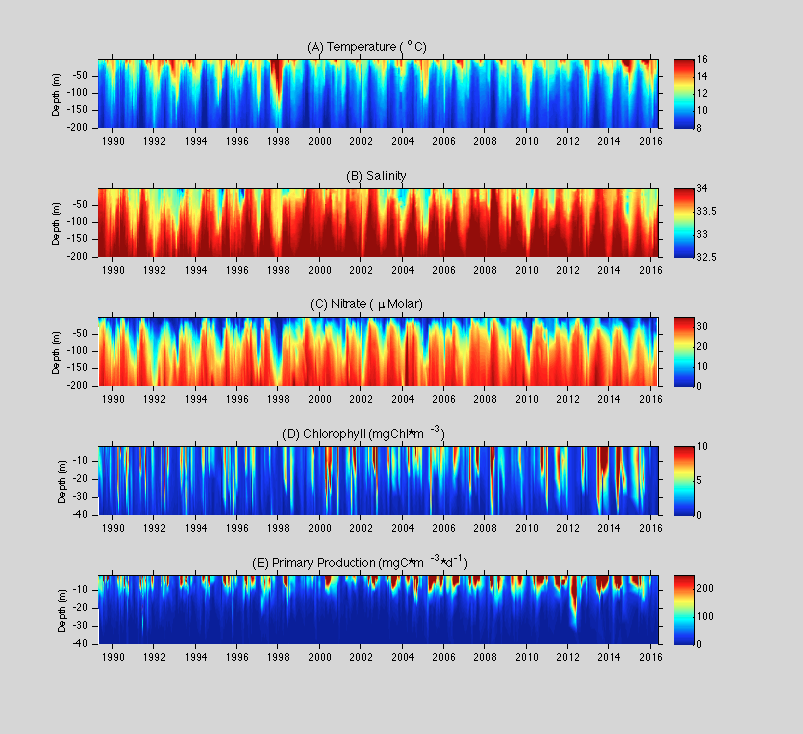
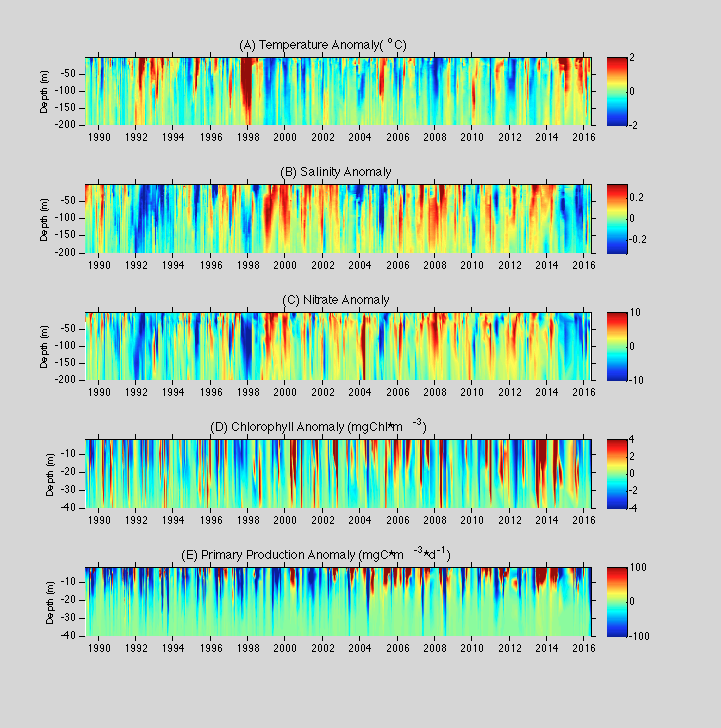
This week has been a lot of MatLab learning for me. I have been working with Reiko Michisaki, a senior research technician, to learn how to access ("query") data from MBARI's massive archives and then visualize the time series and calculate the associated anomalies I will be working with this summer. That in and of itself was a huge accomplishment for me as I had never touch MatLab before. For now I am focusing on the parameters of temperature, salinity, nitrate, chlorophyll, and primary production-the mainstays of the data collected on the CTD cruises-at mooring 1 (M1). There are a lot of interesting aspects of change to analyze and tons of different papers that would be worth producing just from this dataset but as my research question takes shape I am preparing to compare the 1997-98 El Niño and the 15-16 El Niño to one another. In doing this I will also look at other distinctive periods other than the two El Niños --the warm years preceding 97-98, the relatively cool periods after, and the so-called "blob" of 14-15 and compare the climatologies produced when you give each of these events their own treatment As for non-project things it was really cool to be here for DOEST! As "sweepers" on the walking tours we got to hear about a lot of cool things that people are working on: more about the shark cam, the abalone/crab/whelk/mussel experiments (Woo Aileen and Tiffany) going on in the seawater lab, the power buoy, the wave glider...awesome!
Posted by gchavez at Jun 16, 2016 09:58
|
|
Spent this week laying the groundwork for what's to come in my project. First, there's the webpage interface. I've never worked with web design before, so I'm reading up on how to make a page functional using a scala-to-javascript API and how to use a css file to style the page. The webpage will allow operators to edit a file online (like they can do with the current system). Additionally, the parsing mechanic needs ironing out before worrying about the specific syntax of the new language. I worked out a rough class hierarchy for the XML mission schema to outline how things are nested in mission scripts. I now need to integrate this class structure into the parsing system with a watered down, very-much-subject-to-change syntax. Since I've never done this kind of software development before, I'm also learning how to automate testing, so I don't have to manually check a wide range of scenarios every time I make a little change in the code.
Posted by emeckler at Jun 16, 2016 11:30
|
|
This week was spent further refining what I'll be doing for the next 8 weeks in addition to doing some prep for our cruise next Thursday.
Posted by mwoj at Jun 16, 2016 11:55
|
|
Coming to you live from the Rachel Carson! This ship has wifi? It's crazy. My last two days have been pretty much just setting up and figuring out new software. I think my project is going to be comparing different methods of click detection so later they can automate identification, which is going to mean learning about a lot of different programs. It's funny, some of the papers I am supposed to read are the same ones I cited in my senior thesis--the work I'm going to be doing here builds on what I learned from the lab I worked in at UCSD, which is really cool. I'm going to have a pretty comprehensive view, by the time I am done here. The Rachel Carson is so cool! Getting to see an ROV in real life is so surreal. We are inspecting cables at the MARS observatory, and we actually looked at the hydrophone collecting the data I'm working on for my project. I'm really glad I got to come on the cruise today! The only other update I have for the week is that I got to meet Sal Jorgensen and Thom Maughan from Project White Shark and I am still hard-core fangirling over them. Got to meet two scientists I strongly admire on Tuesday, hanging out on a boat with an ROV on Thursday... My first week has shaped up very nicely.
Posted by ejacobs at Jun 16, 2016 12:00
|
|
FROM DALLAS - (posted in week 1) This week has been very exciting for me, so I'm posting my confluence update a day early (I'll be gone tomorrow). On Monday, I had the privilege of joining Dr. Stephanie Bush on the hunt for the opisthoteuthis sp. flapjack octopus! I was told to not get my hopes up as they are not always successful, but opisthoteuthis was the first thing we saw as the ROV hit the bottom. The first 30 minutes were really exciting and then the next 8 hours of sea sickness made the trip a bit less fun, but I had a blast and I'm really glad I went. Tuesday was really interesting, since I'm ahead of schedule on my project, I got to sit in on the presentations during the DOEST board meeting. I was able to gain a better working knowledge of my own project and the role our project plays in the future of MBARI. I was also happy to finally talk to someone in my own field, Microbiology and Clinical Laboratory Science (Dr. Norman Pace). Finally, on Thursday I get to go to SLAC and tour the particle accelerator lab and make contact with other STAR members. I was really excited to nerd out this summer, but this week has been exceptionally geeky. (FYI- Jen and Alaina are pool sharks, proceed with caution)
Posted by mage at Jun 16, 2016 13:38
|
|
FROM TIFFANY - posted in week 1 On the work side of things, I have just been continuing to prepare for my experiment. Aileen and I purchased 3 M/F abalone from Davenport Abalone Farm and our mentor instructed us in abalone husbandry so that we can keep our animals happy until our individual experiments. Excited to continue!
Posted by mage at Jun 16, 2016 13:38
|
|
FROM AILEEN - inserted into the top box instead of comments The second week is about to end and I am starting to feel the pressure already;two weeks went by pretty quickly and it won't be long until we're presenting our research. I'm hoping by the end of this week that I will narrow down my potential research questions to no more than two so I can start planning the methods and gathering supplies.
Posted by mage at Jun 16, 2016 13:45
|
|
This week has been a major learning week for me as I come to understand how CeNCOOS actually operates. We get our money externally so we have a large governing board that oversees our organization and the 50 or so PIs, industry and policymakers. We had a conference call with one of the newest board members and the presentation had more acronyms than I have ever seen but my supervisor here did a great job explaining what each of them stood for. After the presentation, I realized that without the acronyms, their powerpoint would be cluttered with tons of words so I completely understand why they do it but it is going to take a while to get them straight. For the remainder of the week, I will be working on writing an article that talks about a project that CeNCOOS and one of its PIs are currently involved in at Humboldt Bay. They installed a new feature on a monitoring network that allows real time updates via satellite every 2 minutes as opposed to having a technician download and upload the data every 6 months. This project involves the Wiyot Tribe and hopefully if this project goes accordingly, we can get more involved with native communities that care about the stewardship of the land as much as we do. Next week, my mentor and I will outline my main deliverable for the summer - a large piece on ocean acidification, the players involved, what is at stake and how CeNCOOS' monitoring system can help policymakers and aquaculture.
Posted by desmond at Jun 16, 2016 13:48
|
|
I can't believe it's nearly the end of week 2, this is going so fast!!!! The DOEST thing was so good and I really like to see how boards members wanted to talk to us about what they do and what we think we wanna do in the future.
Posted by mariacl at Jun 16, 2016 16:50
|
|
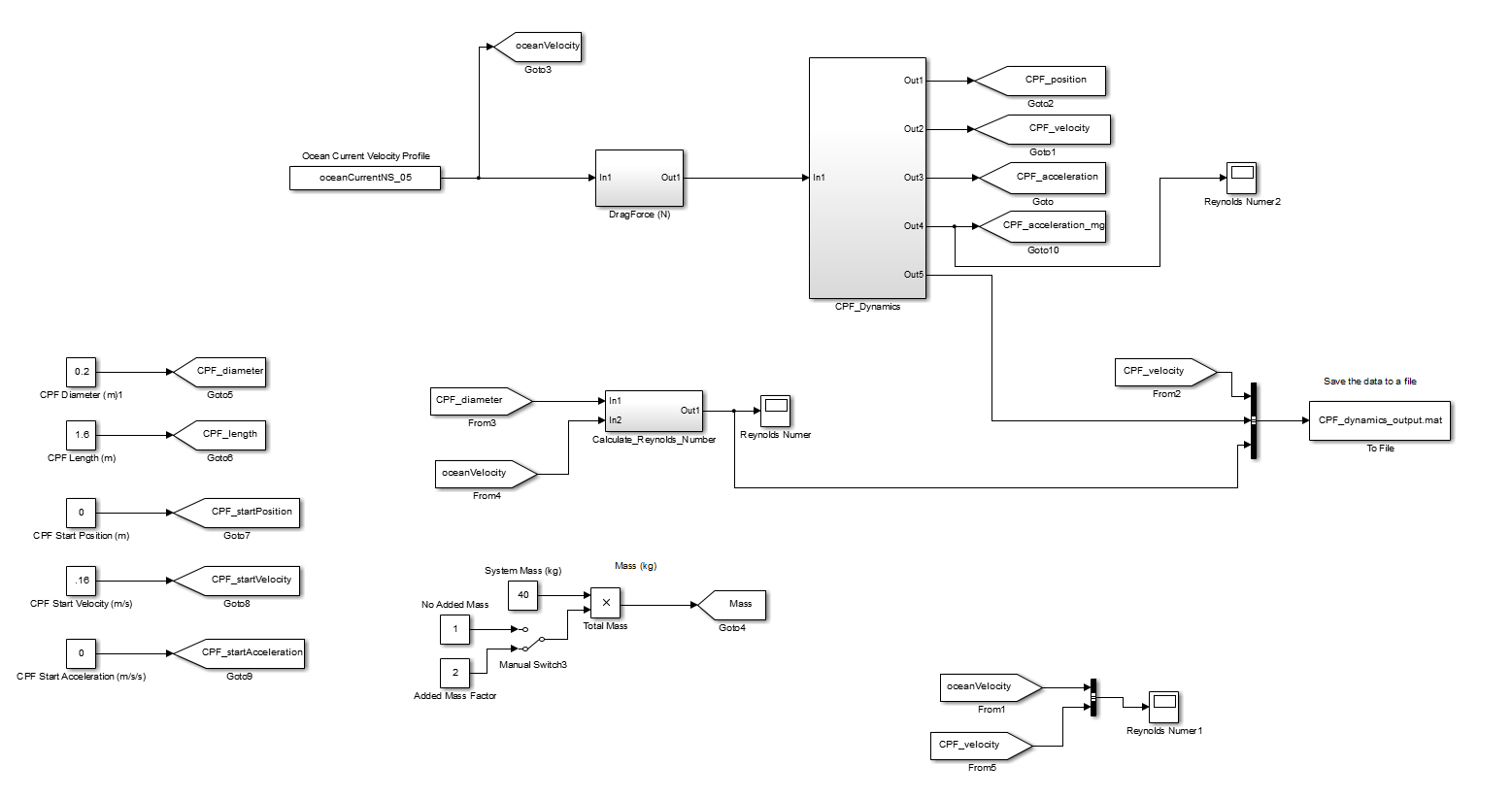
This week was spent developing a simulation model to predict the position, velocity, and acceleration of the float as it drifted in the underwater currents. This is important because we need to know the range of accelerations that we can expect to measure to ensure that our sensor will be sensitive enough to detect the changes in acceleration. Using real data collected from a moored buoy in Monterey Bay, M1, I was able to download a CSV file of underwater current profiles from February 1998 and use this information as the input to my model. This particular data was chosen because it had strong underwater currents. Since the float has no active propulsion or steering, the only force acting on the float is caused by hydrodynamic drag. Assuming that the physical shape of the float can be modeled as a cylinder (pretty good assumption) it was possible to calculate the drag force acting on the float as it moved through the water at different velocities. Here we are assuming that the drag force is proportional to the square of the velocity of the object, which is why it was important to use real data about the underwater currents in Monterey. The historical data was obtained from the MBARI Live Access to DATA website: http://dods.mbari.org/lasOASIS/main.pl??&. The rest of the week was spent developing the model in Simulink and testing the model to verify that the outputs were correct. Once complete, a set of plots was created so that we could look at all the data together. Based on this work, it looks like the range of expected accelerations that we need to detect will be from 0.05 to - 0.05 m/s/s. These are very small accelerations, and the sensor that we are currently using may not be sensitive enough to detect this without post processing and filtering of the data.
The next step (plans for next week) is to start testing the actual IMU sensor to characterize the noise profile and determine the smallest possible acceleration that we will be able to detect. To accomplish this, we are using a computer controlled moving table in the lab. We will mount the sensor to the table and accelerate the table very slowly and read the output from the IMU. By testing a range of acceleration, we can determine the sensitivity and noise profile of the sensor and compare this with the results from the dynamic simulation. Bonus - on Thursday I went on the Rachel Carson for an all day cruise and was able to fly the ROV Ventana for a bit. SUPER COOL!
Posted by nraymond at Jun 17, 2016 08:44
|
|
Hi all, Apologies for this very late post, last Thursday I was busy in the Flyer control room searching for and collecting invertebrates several hundred meters below Monterey Bay's water surface, and I've been delayed in posting this since. Thursday at 6pm one of the most exciting and challenging trips of my life came to a close as the Western Flyer, its incredible crew, the Haddock lab (+ intern), and visiting scientists came into port. Here is a very brief documentation of this adventure from my perspective, but as it is brief, please feel free to ask me about it in person - I will enthusiastically describe every detail of my experience! Before I boarded the Flyer last Friday, I felt a mix of overwhelming excitement and apprehension. Not only was this my first overnight trip on a boat, but I embarked on it with a lab group I had only become acquainted with for four days. There were still plenty of unknowns and first impressions to make. Shortly before this trip, ROV engineers and Dr. Steve Haddock developed a new videocamera for the ROV capable of detecting and recording bioluminescence in the lightless deep sea environment, and this cruise marked its first official research use. Not only did the videocamera work perfectly, but we recorded some truly impressive displays of bioluminescence. Doc Ricketts was deployed every day we were at sea after Friday, collecting samples for everyone's projects and supplying the video lab with 5 days worth of footage. I was able to sit in the ROV control room and operate the camera, which was fun because everyone in the room was a deep sea animal expert, and could give the scientific name of nearly everything that passed the video screens. I ended up learning a ton about the animals that exist at depth. Since I am studying bioluminescence with light-sensitive animals and equipment, I spent quite a bit of time becoming familiar with running experiments in a small, completely dark room on a constantly rocking ship. It was definitely challenging, but I collected some great data and was able to chemically stimulate bioluminescence from doliolid (tunicates) and radiolarian photoproteins. The experiments I ran this week will serve as preliminary research for what I'll be doing during the next eight weeks (yay!). Probably one of the best parts about the trip was the people I had the opportunity to get to know. For one, the Haddock lab is an awesome group of friendly and accomplished professionals who will no doubt foster my growth as a person and scientist (lucky me!). Additionally, the crew was a talented group of friendly individuals, and our chef was fantastic. I heard many great stories and learned something new from almost everyone on the ship. So, if I could do it all over again or recommend the experience to anyone, I definitely would. I'm grateful to the Haddock lab, MBARI, and the internship coordinators for allowing me to be apart of this amazing experience!
Posted by cpayne at Jun 23, 2016 09:46
|