|
This page last changed on Jun 16, 2016 by mage.
click on the add comments button below to post your update
|
Most of this week has been spent finalizing my project and determining the details of my experiment. I finally have an idea on what my project is and I seem to have all my methods down. All that's left to do is double-check with my mentor, make any necessary corrections, and start collecting the materials I need! Hopefully, I can start my project soon but with the seawater system undergoing repairs I am unsure when exactly I can start, meaning I can't create a project timeline that is set in stone...
I'm quite looking for the barbecue tomorrow at Hopkins. Going to be aboard the Rachel Carson in the morning then dinner afterwards, so tomorrow is gonna (hopefully) be a relaxing day. It's going to be awesome meeting interns who are working in the area and from programs I didn't know existed!

Posted by asan at Jun 22, 2016 15:25
|
|
I spent this week integrating two halves of this parsing mechanism. Now, I can take a string input and parse it into a class hierarchy that reflects the XML schema to which the mission scripts adhere. This class hierarchy still needs refining, as the XML schema (computer generated in this case) is not super readable. I also began exploring how to take an instance of the class hierarchy and turn it into XML code that satisfies the schema. Next week I will spend some time investigating a tool that may be able to automate those two steps for me: given an XML schema, it could theoretically produce a case class hierarchy and, given an instance of that hierarchy, produce a valid XML file. The tool is not exactly bug-free, though, so I need to verify that it will work for our purposes.
Additionally, I will begin putting more effort into the user interface next week. An important part of the domain-specific language is useful and easy-to-understand feedback, so developing that is important. Error reporting right now will only be focused on the syntax given--the semantic analysis of inputs is complicated and will have to come later.
I'm posting so early because I'm going out on the Rachel Carson tomorrow! Should be a blast, I'm excited. See you all at the BBQ, if not out at sea!
Posted by emeckler at Jun 22, 2016 17:31
|
|
This week has mostly been devoted to post-cruise processing and project organization. We unloaded the Flyer last Friday/this Monday, and tomorrow I will be going through the samples I collected (doliolid tunicates) so that I can start running some assays in our luminometer and integrating sphere. My preliminary assays on the cruise showed me that doliolids have photoproteins, which are proteins that, when bound to their complimentary light-emitting compound, called a luciferin, emit light (bioluminescence). I found these photoproteins to be activated by calcium. The purpose of these next assays will be to 1) determine the conditions (ex. pH) under which the photoproteins emit the greatest light intensity, 2) determine if luciferins other than calcium activate the photoproteins, and 3) attempt to regenerate photoproteins that have already bound to a luciferin and been "spent". Should be pretty fun!
Posted by cpayne at Jun 22, 2016 20:30
|
|
This week I have been working on proposal things for REU as well as partaking in some lab work. On Tuesday I did DNA extractions which was 3 hours of pipetting and throwing away lots of gloves. I had a good time though, lab work although tedious is just super cool to me. We also used a nanoDrop which shows the concentration of DNA in the sample after extraction. Out of 17 only 3 were a little bit iffy with the DNA content. Yesterday, I sat in on a MBON call with Kris, Reiko and Kevan and learned more about eDNA and methods involved in collecting it. Today I'll probably be working on some more proposal things as well as doing some PCR with the DNA extractions.
Posted by bcorbett at Jun 23, 2016 09:11
|
|
We heard from our partners that the analysis of the videos we sent were unsuccessful. In making more videos for them, I noticed a major inconsistency in the process. The dive videos have a specific "timecode" associated with them in Hours:minutes:seconds:frames and this timecode seems to be somewhat arbitrarily set in the sense that they do not start at time 0. Instead they start somewhere like 14:23:22:10 or 01:04:23:05 and so on. When we record the tape onto a removable/shareable movie, the movie is in hours:minutes:seconds and starts at 00:00:00 like normal. Not a big deal, but what I found is that when converting the tape timecode into quicktime movie minutes, the zero time given wasn't specific enough. In other words they were given an estimate of where the tape started rather than the actual time. This resulted in some organisms only being off by a few seconds, but in some of the videos we sent, the classified organism was off by 48 seconds! So imagine teaching a computer to "see" and learn what a chair is, but instead of showing it a chair, you show it a house and say, "its somewhere in there." I spent the week analyzing the video, becoming a species identification master, recognizing a pattern associated with the data, deducing what the actual timecode was, converting it into quicktime movie minutes, and re-submitting our data to our partners. On top of all that, I also created a procedure manual for the most efficient and time exact technique moving forward. Just in this week I was able to fix all the videos that were sent pre-internship, tripled the amount of new videos that our partners will receive (the process really is a lot faster now), and have developed a level of consistency that will prove very useful since everyone who requests this data will now get the same type of data and can compare their results. We are now moving to mid-water organisms which should be even more difficult. Imagine you want to teach the computer to see a chair that can swim... Im hoping in the next few weeks we can start to analyze the videos in-house with our own algorithms!
Posted by dhollis at Jun 23, 2016 09:14
|
|
It's the third week and I still didn't meet my mentor Alexandra Worden and my second mentor has been on vacation the entire week until next Tuesday so I have been working by myself at the lab. I really like it because I'm getting more and more confident at the lab but I still sometimes have questions so I'm also very lucky to have the coworkers that I have. Everyone is so patience with me and my english and they're always willing to help me.
This week I have been doing more or less the same than the last week, making my cultures grow and measuring if it's working or not. We need so much Micromonas because we will have 12 flasks and be sampling like every 2 hours for ~24 hours, so if each sample is 1mL, we need a lot of volume. It's a lot of work, pipetting all the time and I need to do it at the same time everyday, but I love working on a lab so I'm really enjoying!
Next week I will finally meet my mentor so we can talk more about my project.
Posted by mariacl at Jun 23, 2016 09:35
|
|
Is it me or did the past few days seem to just zip by?!?
Chris Scholin had a few key points in his director's dialogue last Thursday that struck me, particularly MBARI's need (and the Board of Directors' desire for MBARI) to effectively communicate the research and technology being done here to broader audiences. Since his dialogue talk, I've been feeling a sense of pressure (self-imposed, of course) to nail my project—if I can execute the content and presentation just right, it could possibly serve as a model in facilitating newer methods of outreach and information dissemination.
This week, I've continued researching, gathering information and reference materials for use in developing content for the Story Map website. I've also been reading up on science communication methods and am finding so much overlap with what I learned in the Creative Advertising program at SJSU. The challenge I've had lately is figuring out a connection between the general public and the importance of studying the Southern Ocean (and MBARI's role in researching that). I certainly don't want to be presenting just facts and data; the reader will lose interest without a personal, relatable tie in. During the questions and comments following Anela Choy's DOEST presentation, a member from the audience made light of that exact need. Facts alone simply don't resonate without some type of emotional appeal. I feel Maslow's hierarchy of needs looming over my shoulder...
With my mentor, Susan von Thun, and possibly also with the help of George, I'm hoping to get in on one of the aquarium's weekly communications meetings in the near future. I'm curious to learn how their social media, advertising, and marketing teams collaborate. The aquarium does a spectacular job with public outreach; perhaps meeting with them will provide me insight in how I can connect my project's subject matter with general audiences.
Upon her return from a week on the Flyer, Nancy Barr has been tinkering with embedding a mock up Story Map I created into MBARI's website. Staging was mildly successful and we're exploring alternatives. In the coming weeks, I'll be tapping into her know-how of MBARI's "voice" as she'll be assisting with editing my content.
Since Desmond is also utilizing the Story Map app for his project, we met yesterday (Weds) to bounce around ideas. Turns out, Esri just released a beta Story Map style that is more along the lines of the parallax website styles that Susan and I were initially going for. It's definitely a game changer and I'm totally stoked – so, thank you Desmond for showing me this!
Other tidbits...
– During one of my workout runs to the dunes this week, I took a beachcoming break and found a pinniped skull, yowza!
– Went to the library at MLML twice this week. Great little quiet place to work with epic oceanfront views to distract you. I love how they use the old-school system of filling out/filing cards to check out books.
– All day breakfast burritos from the Snack Shack are awesome!
Posted by jvalenzuela at Jun 23, 2016 10:48
|
|
This week has been a continuation of last week except now my mentor has gone and vacation! Luckily MBARI is full of incredibly helpful geniuses so I'm not completely on my own as I continue to work on my MatLab skills, further analyze the datasets I've been already been working with, incorporate new datasets to increase coverage of certain parameters, and begin the process of primary component analysis (PCA) -something completely new to me.
I've also spent a lot of this week reviewing related literature and seeing how I can use previous findings to inform my own paper-for example, some researchers (UCSC) JUST published a paper on this El Niño and the Blob in comparison to 97-98 in the California Current system which essentially encompasses a lot of the analysis I had started to build for my own study. Not that the analysis of Monterey Bay on its own, using completely different datasets, is now invalid, but it has pushed me to look at new analyses I could incorporate into my paper as well. In oceanography people are publishing their findings every day so it's important to utilize this new information to take our own projects farther in the hopes of delivering a worthwhile contribution to the collective understanding of the changing ocean
Posted by gchavez at Jun 23, 2016 12:06
|
|
This week has been a lot of teeth grit. While my project's timeline is still on track, I found that the open-source software that I was going to be using to track sperm motility doesn't work and is unsupported. I am switching gears to a new program called ImageJ that has a plugin developed to do the analysis I need. The documentation is lengthy however, so it's been a steep learning curve.
Besides that main bottleneck, I have been gathering materials and fine-tuning my methods so come experiment day I will be as fast and efficient as possible. I want to test the effect of pH and dissolved oxygen on sperm motility. The motility metrics I am analyzing are velocity, curvature, and the most simple, but telling: whether they are moving or not.
Had a great weekly meeting with our collaborators at Hopkins. It's very cool understanding the larger picture in ocean acidification research that my little experiment is contributing to.
P.S. Thanks for the all day breakfast burrito tip Jen. I shall definitely be taking advantage of that!
Posted by tthisner at Jun 23, 2016 13:06
|
|
Some day I won't forget to do my Confluence update on time, but unfortunately today is not that day.
This week I finally got past most of my hardware issues, so now I'm actually learning how to use all the software that I'm supposed to be using. I got them to increase the memory of the computer I'm virtually connected to so I can easily process data using Pamguard, so I ran some different clips through it and found out, from clicking around and looking at things it detected as beaked whales vs not beaked whales that it's a really bad detector. Someone sent me some updates for it that will hopefully make it less bad, but I haven't managed to make those work yet. But there were a lot of false negatives, which makes me think that this update, which allows some fine tuning of the detection parameters to allow counting zero crossings without requiring frequency upsweep, would improve it a lot.
The biggest theme for this week is mismatching detection parameters! The reason Pamguard is so bad is that the guy who made it thought that beaked whale signals looked like one thing, but the lady I'm working with on the Pamguard stuff thinks they look a different way, and then the other lady from the Naval Post-Graduate school whose hand-detected data is supposed to be acting as my ground truth thinks they look a different way... This is a problem, if I'm supposed to be comparing methods of detection. I need them to be looking for the same thing before I can compare how good they are at finding it. Small amounts of deviation can be accounted for in the analysis of the methods, but if I am correct I think that a majority of the beaked whale clicks are not being counted in some of the detectors, which is a big issue.
This afternoon I started looking through some wav files on Audacity to hear actual whale sounds, which is so cool! I found some files that were shared by the old lab I worked in, so I really enjoyed getting to actually listen to the data that I spent all of last year analyzing. It's so amazing to me that I'm sitting at my desk here listening to giant whales swimming around in Southern California or Monterey Bay (depending on the data set) just chillin', diving for fish or chatting with their buddies. There's a whole world of sounds out there that we're just starting to listen to. And the possibilities for research from that sound... it makes me really excited to be getting into the field of acoustics when it's still so new, because there's a lot of uncharted territory that technology is just now starting to uncover.
But anyway, I'm mostly still slogging my way through learning how to use the software, but it's a lot less frustrating than it was when I was just watching my computer crash due to insufficient memory. I'm spending less and less time sitting around waiting for things to load, which has greatly improved my enjoyment of my day, so things are looking up. Come find me if you want to listen to some whale sounds!
Posted by ejacobs at Jun 23, 2016 16:42
|
|
Somehow the hardest thing to remember at MBARI so far besides how to navigate through the different buildings is to write my confluence update each week. I swear that I will do this week on time 
This week I attempted to use ArcGIS on my work computer but it just does not want to go. I went around and got another license from my university to put on my personal computer. This allows me to create maps for the story map that I am creating. I am 2/3 of my way finished with the first draft of my first story map on ocean acidification. The missing pieces that I need are pages to tie in CeNCOOS to OA without it being encumbered with too much information. However, I am finding it difficult to explain everything that CeNCOOS does while using the minimal number of words and pages.
My mentor and I have setup a meeting time with the founders of Hog Island Oyster Company so that we are able to interview them to get an idea of what the information that we provide does for them. In addition, I can use the opportunity to get some pictures of the area and of the oyster farm for the story map. The only downside is that the only available date they have in July is next Friday July 8th, so I will be working that day. However, it is a great opportunity to meet them and get the final piece that I need to complete my first story map.
On a different note, Jen and I checked out Phil's Snack Shack where they have breakfast burritos for $5~6 and they are massive, definitely enough for 2 meals!
Posted by desmond at Jun 27, 2016 08:18
|
|
A bit late on this one, didn't think to complete my update before going out on the Carson on Thursday...
Anyway, that does mean I can report a bit on the cruise itself, which was very successful! We started out down at about 800m and found and captured a jelly pretty quickly. The argon flooding system was incredibly successful, working seamlessly even though this was the first time anyone had tried it. I have to say pressurized jellies without any water surrounding them are one of the strangest things I've seen. They maintained a film of water for a little bit from the surface tension, but they really do have a very jell-o looking consistency and surprisingly reflective surface. We were able to collect seawater spectra and jelly spectra at five or six different depths between 800m and 300m, and can very conclusively say that jellyfish are different from seawater... Shocking, right?
This week will involve lots of data analysis from the spectra we collected, including figuring out the origin of an as-yet unexplained sharp negative peak in the middle of the water stretching mode peaks. We think it's an absorbtion line from the argon we filled the D-sampler with, but we'll have to do some benchtop testing of backlit pressurized argon to be sure.
We also collected a few water samples at depth that we plan to use to characterize the T-P-S dependence of the relative sizes of the water stretching peaks. This will be useful because we expect the jellies to be in temperature and pressure equilibrium with the surrounding water, so we may be able to determine their salinity from the spectral data alone, assuming a well-defined marker can be found. This will be the beginnings of discovering what (if any) salt exclusions jellies are capable of.
Before going out on the cruise, I was able to write a GUI MATLAB program that allows the user to define a spectral baseline in terms of Piecewise Cubic Hermite Polynomials (a MATLAB fit algorithm that's already part of the curvefitting toolbox, I just built the GUI for it), then fits the resulting baseline-corrected data with five Gaussian curves (corresponding to the five water stretching modes). This was the solution we came up with for the problem of baseline calculation I talked about in the previous confluence post. There are a few minor tweaks I need to make to this program this week, increasing the user-friendliness and possibly adopting a two peak fit version for the water bending modes, but mostly it will involve making use of the program on the data we collected.
Posted by mwoj at Jun 27, 2016 08:19
|
|
(Sorry... this is late)
This week was spent learning how to make a data logger using C# and the GHI 400 board. I have done this before using Matlab and C++, but we are using a different type of micro-controller so I had to write a new program in C# to read data from the IMU and save it to an SD card. The data logger needs to be able to read and write data at a speed of more the 20 read/writes per seconds, so the code must be efficient. Most of my time was spent learning about the SD card protocols and methods from online references. I was still having issues by the end of Thursday, so I decided to work a half day in the lab on Friday to get caught up.
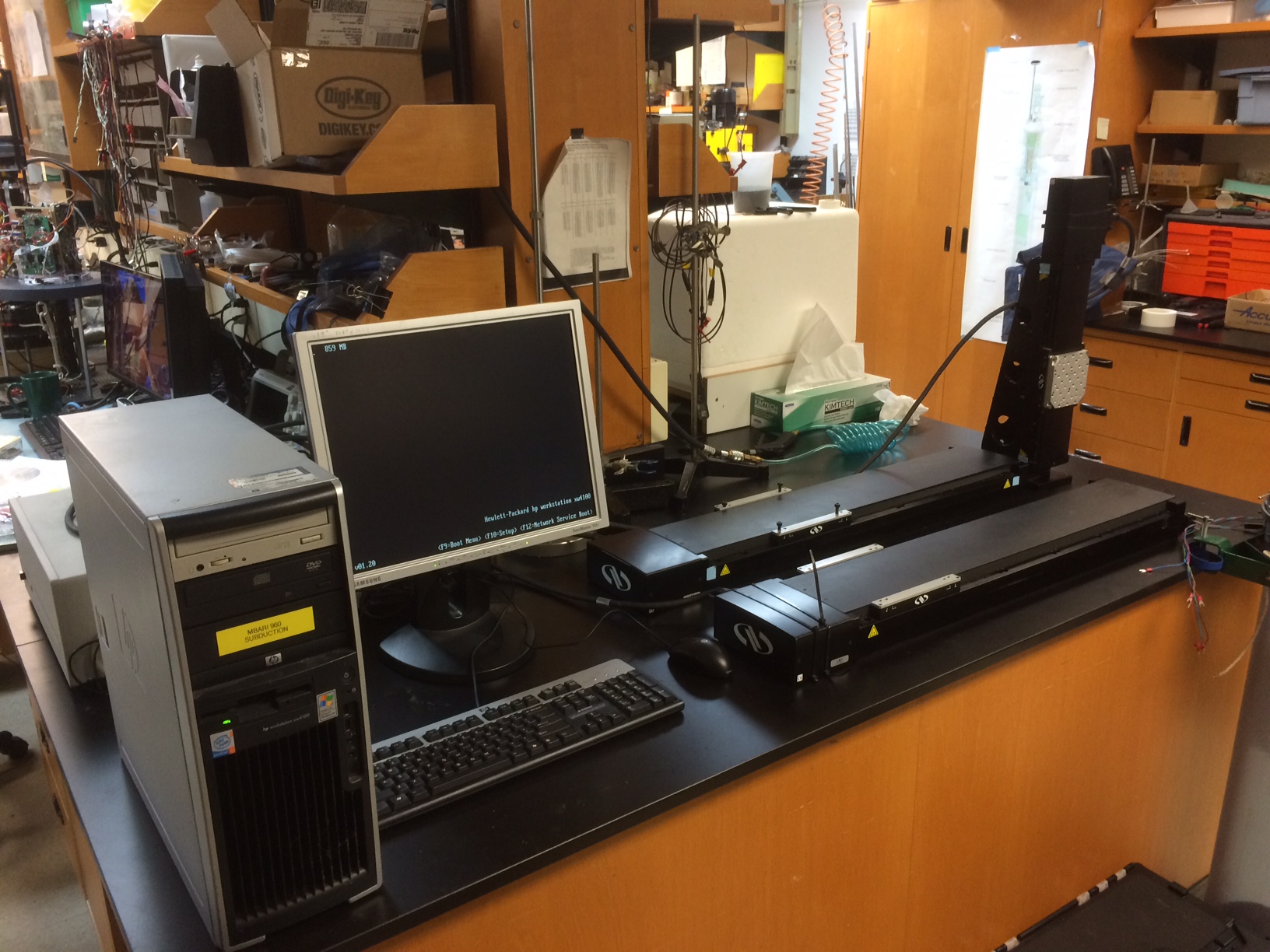
When I was not writing code, I was setting up the linear translation stage that we will be using for our bench top experiments. Initially we were using an older computer that was running XP, however after it booted up the mechanical hard drive failed (due to age) so the memory was lost. Most of Tuesday was spent problem solving and looking for another computer that ran XP (the linear translation stage control software is not compatible with Windows 7) and reinstalling the drivers and control software on the new computer.
The linear translation stage is now fully operational and ready for testing. I plan to finish writing the data logger code on Monday.
Bonus: got to go out on a small boat this week with two of the engineering technicians from the lab to change the batteries on one of the moored buoys in the Salinas River area. The buoy has a CTD and nitrate sensor and sends the data back to the lab every hour. It was great to get away from the computer for an few hours and ride up the river. Field work is FUN!
Goals for next week:
1. Finish the data logger code, test and verify it is read/writing at 20 Hz.
2. Prepare presentation slides for my engineering talk on Wednesday with Andy Hamilton.
3. Engineering meeting on Wed. to discuss my simulink model for the CPF dynamics
4. Learn about Allen Variance testing to characterize noise of sensors
5. Setup linear translation stage and modify acceleration profile to provide continuous output.
Posted by nraymond at Jun 27, 2016 08:19
|
|
This is really late I know. So last week I was working on mapping the Dorado data. I was able to make scatter plots and so I know exactly where the data was taken at what it looks like. On Thursday I was out on the boat and the Bronine or whatever medicine I took knocked me out so I was pretty much asleep the whole time. But I didn't get sea sick so that was cool. The ROV room was pretty awesome too. It was funny to see how excited everyone got when they successfully caught a jelly, which was pretty impressive so it was warranted. It was excited to be out on such a successful and cool trip!
I will be updating confluence for this week right now so don't worry!
Posted by asmith at Jun 29, 2016 10:12
|
|
Well this is awkward.. I would have sworn that I turned in a report for last week but I guess it never got properly submitted. Come to think of it, its pretty fitting that I wasted time typing out a report that didn't get submitted for the week that I wasted time watching and annotating footage that I would end up not using in my research haha. That being said, I just submitted a report for the 30th that gives a detailed description of my updated research project for whoever is interested! I basically spent all of last week going through ROV footage from pulse 65, counting individuals for Cystocrepis setigera and Cystechinus loveni, and measuring their lengths and widths.
Posted by dfabian at Jun 30, 2016 11:47
|
|
joining the late club...
I have spent my week in a bottomless matlab pit, of which I have still not been able to work my way out. I've been working on rotary analysis of the current meter data on the Rover. Rotary analysis involves the separation of the velocity vector for a specified frequency, into clockwise and counterclockwise rotating circular components. So instead of dealing with the cartesian velocity data (U,V, or the east and north velocity field that the CM measures) you deal with the circular components. This reveals important aspect of the wave field particularly at the depth at which the rover is deployed (it is dominated by a few frequencies, think tides)
The problem I keep running into is that the way that matlab deals with this math is via 7-dimensional matrices, and the periods I'm looking at are so long that it crashes the program and my computer. I only figured this out after having dowloaded the newest version of matlab, which recognized the problem before running the script. Now I have to decide how to run this analysis on truncated segments of the data in a way that makes sense.
Posted by dburrier at Jun 30, 2016 15:39
|
|