Base socket-level interface to the ESP. More...
#include <ESPComm.h>
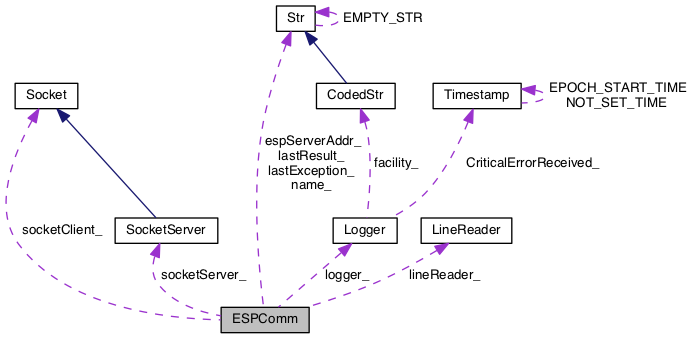
Public Types | |
| enum | Error { OK = 0, CANNOT_OPEN_SOCKET_PORT, TIMEOUT_ACCEPT_CLIENT, CANNOT_ACCEPT_CLIENT, PORT_NOT_OPEN, TIMEOUT_CONNECTING, CANNOT_CONNECT } |
| Errors. More... | |
| enum | EspStream { UNKNOWN = 0, RESULT = 0201, OUTPUT = 0202, EXCEPTION = 0203, LOG = 0204, SET_PROMPT = 0205, STATE_VEC = 0206, STATUS = 0207, PROMPT = 0200 } |
| the ESP virtual streams More... | |
| enum | EspState { ES_UNKNOWN, ES_IDLE, ES_LOADING, ES_READY, ES_FILTERING, ES_PAUSED, ES_FILTERING_ERR, ES_PROCESSING, ES_PROCESS_FAILED, ES_PROCESSED, ES_UNLOADING } |
Public Member Functions | |
| ESPComm (Str name, const int serverSocketPort, Logger &logger, size_t readBufferSize=1024) | |
| Constructor for when the LRAUV is to act as the server in the socket communication. More... | |
| ESPComm (Str name, const char *espServerAddr, const int espServerPort, Logger &logger, size_t readBufferSize=1024) | |
| Constructor for when the remote ESP acts as the server in the socket communication. More... | |
| ~ESPComm () | |
| Destructor. More... | |
| ESPComm & | open () |
| Starts the server on the given port. More... | |
| ESPComm & | acceptClient (int timeoutMillis=0) |
| Client connection accept with timeout (0 by default) More... | |
| Str | getPeerAddress () |
| Gets the address of peer connected to the client socket. More... | |
| ESPComm & | connectAsClient () |
| Can be called when hasEspServerAddressAndPort is true. More... | |
| ESPComm & | connectAsClient (int timeoutMillis) |
| Similar to connectAsClient() but with timeout. More... | |
| ESPComm & | setEspServerAddressAndPort (Str espServerAddr, const int espServerPort) |
| Sets the address and port of the ESP server. More... | |
| bool | hasEspServerAddressAndPort () |
| Do we already know the address and port where the ESP is/will be running as server? More... | |
| Str | showEspServerAddressAndPort () |
| log helper: "address:port" string with the espServerAddr_ and espServerPort fields. More... | |
| ESPComm & | submitAbort () |
| Issues command to request the ESP to interrupt the thread associated with this client. More... | |
| bool | isClientConnected () |
| is a client connected? More... | |
| ESPComm & | close () |
| Closes underlying sockets. More... | |
| virtual bool | isReadable () |
| virtual bool | eof () |
| virtual bool | isWritable () |
| const char * | streamName (EspStream stream) |
| const char * | espStateName (EspState espState) |
| EspState | espStateFromReportedString (const char *str) |
| void | setEspLogFile (const char *path, bool onlyLog=true) |
| Received lines from the ESP are reported in the given file. More... | |
| int | readLine (char *buffer, size_t bufferSize, EspStream *stream=0) |
| Reads a line (non-blocking) from the ESP. More... | |
| EspState | getEspState () |
| EspStream | getCurrentStream () |
| Str * | getLastResult () |
| Gets the last result received from the ESP. More... | |
| Str * | getLastException () |
| Gets the last exception received from the ESP. More... | |
| int | sendLine (const char *buffer, size_t bufferSize=0xFFFFFFFF) |
| Sends a single line to the ESP. More... | |
| Str | escape (const char *buffer, size_t bufferSize=0xFFFFFFFF) |
| Debugging utility: returns a readable version of contents received from the ESP. More... | |
| ESPComm::Error | getError () |
| get last error More... | |
| bool | hasError () |
| const char * | errorString () |
| void | setDebug (bool debugOn) |
Private Member Functions | |
| ESPComm (const ESPComm &old) | |
| int | sendLineAux (Socket *socket, const char *buffer, size_t bufferSize=0xFFFFFFFF) |
| void | logDebug (Str msg) |
| void | logError (Str msg) |
Private Attributes | |
| Str | name_ |
| int | serverSocketPort_ |
| SocketServer * | socketServer_ |
| Str | espServerAddr_ |
| int | espServerPort_ |
| Socket * | socketClient_ |
| LineReader * | lineReader_ |
| size_t | readBufferSize_ |
| EspStream | currentStream_ |
| Str | lastResult_ |
| bool | lastResultComplete_ |
| Str | lastException_ |
| bool | lastExceptionComplete_ |
| EspState | espState_ |
| ESPComm::Error | lastError_ |
| Logger | logger_ |
| std::ofstream * | espLogFile_ |
| bool | onlyLog_ |
| bool | debug_ |
Detailed Description
Base socket-level interface to the ESP.
Besides communication establishment, provides basic operations (readLine, sendLine) to support implementation of the actual ESP component.
Member Enumeration Documentation
| enum ESPComm::Error |
| enum ESPComm::EspState |
| enum ESPComm::EspStream |
Constructor & Destructor Documentation
| ESPComm::ESPComm | ( | Str | name, |
| const int | serverSocketPort, | ||
| Logger & | logger, | ||
| size_t | readBufferSize = 1024 |
||
| ) |
Constructor for when the LRAUV is to act as the server in the socket communication.
- Parameters
-
name String to identify this instance as an ESP client serverSocketPort The local port for the server socket logger Logger readBufferSize Passed to LineReader; 1024 by default
| ESPComm::ESPComm | ( | Str | name, |
| const char * | espServerAddr, | ||
| const int | espServerPort, | ||
| Logger & | logger, | ||
| size_t | readBufferSize = 1024 |
||
| ) |
Constructor for when the remote ESP acts as the server in the socket communication.
- Parameters
-
name String to identify this instance as an ESP client espServerAddr ESP address espServerPort ESP port logger Logger readBufferSize Passed to LineReader; 1024 by default
| ESPComm::~ESPComm | ( | ) |
Destructor.
References close(), isReadable(), and setEspLogFile().
|
private |
Member Function Documentation
| ESPComm & ESPComm::acceptClient | ( | int | timeoutMillis = 0 | ) |
Client connection accept with timeout (0 by default)
References SocketServer::accept(), CANNOT_ACCEPT_CLIENT, Socket::close(), Str::cStr(), debug_, escape(), espServerAddr_, espServerPort_, Socket::getDescriptor(), SocketException::getErrno(), lastError_, lineReader_, logDebug(), name_, OK, readBufferSize_, Socket::sendall(), serverSocketPort_, socketClient_, socketServer_, and TIMEOUT_ACCEPT_CLIENT.
Referenced by main(), and ESPComponent::waitForESPConnection().
| ESPComm & ESPComm::close | ( | void | ) |
Closes underlying sockets.
References Socket::close(), lastError_, lineReader_, PORT_NOT_OPEN, socketClient_, and socketServer_.
Referenced by open(), ESPComponent::start(), ESPComponent::stop(), ESPComponent::uninitialize(), and ~ESPComm().
| ESPComm & ESPComm::connectAsClient | ( | ) |
Can be called when hasEspServerAddressAndPort is true.
References CANNOT_CONNECT, Str::cStr(), debug_, espServerAddr_, espServerPort_, Socket::getDescriptor(), lastError_, lineReader_, logDebug(), name_, OK, readBufferSize_, Socket::sendall(), and socketClient_.
Referenced by open(), and ESPComponent::starting().
| ESPComm & ESPComm::connectAsClient | ( | int | timeoutMillis | ) |
Similar to connectAsClient() but with timeout.
Uses constructor SocketClient( const char* host, int port, int timeoutMillis ). See SocketClient.h for relevant documentation.
getError() will be ESPComm::TIMEOUT_CONNECTING if there's a connection refused error or there's a timeout connecting.
- Parameters
-
timeoutMillis Timeout in millis. A value of 100 or more has worked well according to testing with client on testhyssim and server on bufflehead.
References CANNOT_CONNECT, Str::cStr(), debug_, espServerAddr_, espServerPort_, Socket::getDescriptor(), SocketException::getErrno(), lastError_, lineReader_, logDebug(), name_, OK, readBufferSize_, Socket::sendall(), socketClient_, and TIMEOUT_CONNECTING.
|
inlinevirtual |
References isReadable().
| const char * ESPComm::errorString | ( | ) |
References CANNOT_ACCEPT_CLIENT, CANNOT_CONNECT, CANNOT_OPEN_SOCKET_PORT, lastError_, OK, PORT_NOT_OPEN, TIMEOUT_ACCEPT_CLIENT, and TIMEOUT_CONNECTING.
Referenced by ESPComponent::openServerSocket().
| Str ESPComm::escape | ( | const char * | buffer, |
| size_t | bufferSize = 0xFFFFFFFF |
||
| ) |
Debugging utility: returns a readable version of contents received from the ESP.
- Parameters
-
buffer string bufferSize size of buffer; if unspecified, strlen is used to determine the size
- Returns
- readable version of contents received from the ESP
Referenced by acceptClient(), ESPClient::checkCmdCompleteTimeout(), ESPClient::checkCmdResultTimeout(), ESPClient::consumeResult(), ESPComponent::getLine(), ESPClient::getLine(), ESPClient::handleException(), ESPClient::issueCommand(), readLine(), sendLineAux(), and ESPComponent::starting().
|
inline |
References Syslog::ERROR, ES_FILTERING, ES_FILTERING_ERR, ES_IDLE, ES_LOADING, ES_PAUSED, ES_PROCESS_FAILED, ES_PROCESSED, ES_PROCESSING, ES_READY, ES_UNKNOWN, ES_UNLOADING, logger_, and Logger::syslog().
Referenced by readLine().
|
inline |
References ES_FILTERING, ES_FILTERING_ERR, ES_IDLE, ES_LOADING, ES_PAUSED, ES_PROCESS_FAILED, ES_PROCESSED, ES_PROCESSING, ES_READY, ES_UNKNOWN, and ES_UNLOADING.
Referenced by readLine().
|
inline |
References currentStream_.
Referenced by ESPClient::advanceInteraction().
|
inline |
get last error
References lastError_.
Referenced by main(), ESPComponent::starting(), and ESPComponent::waitForESPConnection().
|
inline |
References espState_.
Referenced by ESPClient::advanceInteraction(), and readLine().
| Str * ESPComm::getLastException | ( | ) |
Gets the last exception received from the ESP.
- Returns
- 0 if no exception at all has been received or if a previous exception has already been reported. Otherwise the complete last exception. Note: caller is responsible for releasing (delete'ing) the returned object.
References lastException_, and lastExceptionComplete_.
Referenced by ESPClient::getLine().
| Str * ESPComm::getLastResult | ( | ) |
Gets the last result received from the ESP.
- Returns
- result string; 0 if no result at all has yet been received or if a previous result has already been reported. Otherwise the complete last result. Note: caller is responsible for releasing (delete'ing) the returned object.
References lastResult_, and lastResultComplete_.
Referenced by ESPClient::getLine().
| Str ESPComm::getPeerAddress | ( | ) |
Gets the address of peer connected to the client socket.
This is used to switch server/client roles once the ESP connects to the vehicle.
References debug_, Socket::getDescriptor(), logDebug(), and socketClient_.
Referenced by ESPComponent::starting().
|
inline |
References lastError_, and OK.
Referenced by main(), ESPComponent::openServerSocket(), ESPComponent::starting(), and ESPComponent::waitForESPConnection().
|
inline |
Do we already know the address and port where the ESP is/will be running as server?
References espServerAddr_, espServerPort_, and Str::length().
Referenced by ESPComponent::starting().
|
inline |
|
inlinevirtual |
References socketClient_.
Referenced by eof(), open(), ESPComponent::start(), ESPComponent::stop(), and ~ESPComm().
|
inlinevirtual |
References socketClient_.
|
private |
References Syslog::DEBUG, logger_, and Logger::syslog().
Referenced by acceptClient(), connectAsClient(), getPeerAddress(), open(), readLine(), sendLineAux(), setEspLogFile(), and submitAbort().
|
private |
References Syslog::ERROR, logger_, and Logger::syslog().
Referenced by readLine().
| ESPComm & ESPComm::open | ( | ) |
Starts the server on the given port.
References CANNOT_OPEN_SOCKET_PORT, close(), connectAsClient(), debug_, isReadable(), lastError_, logDebug(), OK, serverSocketPort_, and socketServer_.
Referenced by main(), and ESPComponent::openServerSocket().
| int ESPComm::readLine | ( | char * | buffer, |
| size_t | bufferSize, | ||
| EspStream * | stream = 0 |
||
| ) |
Reads a line (non-blocking) from the ESP.
- Parameters
-
buffer output buffer bufferSize size of output buffer stream If not null, associated stream is stored here
- Returns
- See LineReader::readLine for documentation
References Str::cStr(), currentStream_, debug_, escape(), espLogFile_, espState_, espStateFromReportedString(), espStateName(), EXCEPTION, getEspState(), lastException_, lastExceptionComplete_, lastResult_, lastResultComplete_, Str::length(), lineReader_, LOG, logDebug(), logError(), onlyLog_, LineReader::readLine(), RESULT, STATUS, streamName(), and UNKNOWN.
Referenced by ESPComponent::getLine(), and ESPClient::getLine().
| int ESPComm::sendLine | ( | const char * | buffer, |
| size_t | bufferSize = 0xFFFFFFFF |
||
| ) |
Sends a single line to the ESP.
The given string may omit the trailing '
'. The string is encoded as expected by the ESP. This "encoding" is simply the insertion of a NUL character before the '
'. The encoded string is sent out using Socket::sendall.
- Parameters
-
buffer string bufferSize size of buffer; if unspecified, strlen is used to determine the size
- Returns
- The value returned by the internal call to Socket::sendall
References sendLineAux(), and socketClient_.
Referenced by ESPClient::issueCommand().
|
private |
References debug_, escape(), logDebug(), and Socket::sendall().
Referenced by sendLine(), and submitAbort().
|
inline |
References debug_.
Referenced by ESPComponent::createESPComm(), and main().
| void ESPComm::setEspLogFile | ( | const char * | path, |
| bool | onlyLog = true |
||
| ) |
Received lines from the ESP are reported in the given file.
Any previous file specified with this method is first closed.
- Parameters
-
path Path to output file. Can be 0 to cause any previously specified file to be closed. onlyLog true to only report <log> lines; true by default.
References debug_, espLogFile_, logDebug(), Timestamp::Now(), onlyLog_, and Timestamp::toString().
Referenced by ESPComponent::espReady(), main(), and ~ESPComm().
Sets the address and port of the ESP server.
This information can be used for later connection as a client, in particular for the submitAbort call.
This method called after being connected with the vehicle as server once we know the peer address (from the socket connection) and the port, which is explicitly reported by the ESP in a first line in the connection.
- Parameters
-
espServerAddr ESP address espServerPort ESP port
References espServerAddr_, and espServerPort_.
Referenced by ESPComponent::starting(), and ESPComponent::stop().
|
inline |
log helper: "address:port" string with the espServerAddr_ and espServerPort fields.
References espServerAddr_, and espServerPort_.
Referenced by ESPComponent::starting().
|
inline |
References EXCEPTION, LOG, OUTPUT, PROMPT, RESULT, SET_PROMPT, STATUS, and UNKNOWN.
Referenced by ESPClient::getLine(), and readLine().
| ESPComm & ESPComm::submitAbort | ( | ) |
Issues command to request the ESP to interrupt the thread associated with this client.
A new socket is created to make such special "out-of-band" request.
References Socket::close(), Str::cStr(), debug_, espServerAddr_, espServerPort_, lastError_, Str::length(), logDebug(), name_, OK, Socket::sendall(), and sendLineAux().
Member Data Documentation
|
private |
Referenced by getCurrentStream(), and readLine().
|
private |
Referenced by acceptClient(), connectAsClient(), getPeerAddress(), open(), readLine(), sendLineAux(), setDebug(), setEspLogFile(), and submitAbort().
|
private |
Referenced by readLine(), and setEspLogFile().
|
private |
|
private |
|
private |
Referenced by getEspState(), and readLine().
|
private |
Referenced by acceptClient(), close(), connectAsClient(), errorString(), getError(), hasError(), open(), and submitAbort().
|
private |
Referenced by getLastException(), and readLine().
|
private |
Referenced by getLastException(), and readLine().
|
private |
Referenced by getLastResult(), and readLine().
|
private |
Referenced by getLastResult(), and readLine().
|
private |
Referenced by acceptClient(), close(), connectAsClient(), and readLine().
|
private |
Referenced by espStateFromReportedString(), logDebug(), and logError().
|
private |
Referenced by acceptClient(), connectAsClient(), and submitAbort().
|
private |
Referenced by readLine(), and setEspLogFile().
|
private |
Referenced by acceptClient(), and connectAsClient().
|
private |
Referenced by acceptClient(), and open().
|
private |
Referenced by acceptClient(), close(), connectAsClient(), getPeerAddress(), isClientConnected(), isReadable(), isWritable(), and sendLine().
|
private |
Referenced by acceptClient(), close(), and open().
The documentation for this class was generated from the following files:
- /Volumes/ubuntu_share/lrauv-application/Source/scienceModule/ESPComm.h
- /Volumes/ubuntu_share/lrauv-application/Source/scienceModule/ESPComm.cpp